
Admissions By Past Finance Directors, Auditors, Consultants And Others That The District’s Recreation (“RFF”) And Beach (“BFF”) Facility Fees Are Not The Standby Service Charges They Have Represented/Represent
Because staff and past/current Boards have wanted/want our moneys so they can continue to intentionally spend beyond their means, and they’re committed/have been committed to a “means justify(ing) ends”1 philosophy, is it any surprise we’ve been told2 that based upon the alleged authority of NRS 318.197(1)3, the RFF/BFF represent beach and public recreation facility fees4? But since we’ve elsewhere provided legal authorities supporting the proposition that “the nature of (a) tax or charge that a law imposes is not determined by the label given…but (rather)…its operating incidence,”5 here we examine what staff/past and present Boards, trustee-elects, past auditors, and knowledgeable members of our community have consistently admitted insofar as the RFF/BFF is concerned!
Admission No. 1. Their Primary Purpose is to Raise Revenues: In order to determine the true “operating incidence”5 of the RFF/BFF, the number two (2) indicia5 in determining whether a monetary exaction is a “fee,”6 is that it not be collected to raise revenues7. But rather, “as a means of compensating…government for the cost of offering and regulating the special service(s), benefit(s), or privilege(s)” furnished8. Thus as elsewhere stated,
“(T)he crucial factor in determining whether a municipal charge for services constitutes a valid…fee(, or something else,) is whether the charge is related to a specific service provided to the payer, rather than being a general revenue-raising measure…In simpler terms: fees are generally designed to cover the cost of a specific service or benefit provided to the individual or entity paying the fee. Think of it as a user fee, where the person paying directly benefits from the service being provided. N[on-fees (i.e.)] taxes are typically imposed on all residents or businesses within a jurisdiction for the purpose of generating general revenue to support a wide range of public services and programs. Regardless of whether a specific individual or business directly utilizes those services.”
Given our What Are The RFF/BFF According to Us discussion offers substantial evidence that the primary purpose of the RFF/BFF is in fact to raise revenues, we submit this is an admission by means of conduct the RFF/BFF are not what staff and past/current Board members have represented!
Admission No. 2. Thus They Pay For The Equivalent of User Fees at The District’s Public Recreation Venues Where No User Fees Are Charged: The District does not charge user fees at every one of its public recreation facilities. Besides its public parks (like Preston Field & Playground and Village Green) and athletic fields (like Ridgeline Park & Ball Field and Incline Park), other examples include: the disc golf course, skate(board) park, mountain bike pump track, fitness trail, bocce ball park, beach overflow parking lot and a number of miscellaneous lesser recreation facilities. But that doesn’t mean the District doesn’t incur costs to maintain, improve, renovate and coordinate access to these facilities. Therefore at the Board’s March 3, 2016 meeting, former Finance Director Gerry Eick offered an “executive summary” in the “context…need(ed) for (then upcoming 2016-17) budget deliberations.” In that summary he presented a series of descriptive slides9 which depicted his testimony as to the alleged benefits of the RFF. Insofar as the District’s public recreational venues where no user fees are assessed are concerned, Mr. Eick testified that:
Because there is essentially no other “user fee process (available) to generate a source” of revenue (necessary) to pay for the costs associated with these facilities, other than the RFF, those whose properties (a)re assessed should consider the RFF to be a user fee substitute.”10.
Given our What Are The RFF/BFF According to Us discussion offers substantial evidence that the primary purpose of the RFF/BFF is to raise revenues, we submit this is another admission the RFF/BFF are not what staff and past/current Board members have represented!
Admission No. 3. They‘re Determined Before Budgeting to Overspend: It’s not so much that the RFF/BFF represent the financial shortfall between budgeted revenues and intentional overspending11 systemwide, but that the Board first determines what the RFF/BFF will be and only afterwards, budgets to this level of overspending. Just listen to staff’s admission this is the process the Board goes through each year prior to adopting a budget:
“A significant component of the final…budget impacting the District’s Community Services and Beach funds is the adjustment to the Recreation…and Beach Facility Fee(s) assessed on property owners for the (up)coming fiscal year.”12 Consistent with “Board of Trustees direction (which) has been provided to retain the combined Facility Fee at $780 for FY 2022-2313…the Recreation Facility Fee (was pre)set at $450, and (the) Beach Facility Fee (was pre)set at $330.”14
Given the above admission, how can anyone conclude that the primary purpose of the District’s BFF/RFF is for any reason other than raising revenues to pay for intentional overspending? We submit this represents another admission the RFF/BFF are not what staff and past/current Board members have represented!
Admission No. 4. They Pay For The Financial Sustainability of The Beaches And Public Recreation Facilities: Listen to Trustee Mick Homan’s views on the RFF/BFF after elected to office in 2024, and prior to taking his oath of office15:
“The(se) fee(s) ha(ve) historically funded capital improvements and operating shortfalls at all of our recreation facilities at some point in our history…(In addition) many of our recreation facilities will not stand on their own financially and (thus)…require some level of facility ‘fee’ to survive and thrive. That facility ‘fee’ is what many refer to as a ‘subsidy’…(And for these reasons) I support the continued utilization of the(se) ‘fee(s)’ to (financially) support our venues. (Because) without (them), our facilities are simply not (financially) sustainable.”
Mr. Homan isn’t the only one. Listen to the District’s former Finance Director, Paul Navazio:
“Annual Recreation…and Beach Facility Fees…are established based on the revenues required16 to (financially) support debt, capital expenditure and operations for the District’s various recreation and beach facilities. These revenues, combined with service charges collected by the District for facility use and program activities, serve to (financially) support (all of) the operations of the District funded by the Community Services Fund (insofar as the RFF is concerned) and beaches funded by the Beach Fund (insofar as the BFF is concerned), respectively.”17
As well as Bob Harrison, the District’s General Manager (“GM”) at the time this page was updated:
“Each year, IVGID establishes…annual…’Facility Fees’ – collected from property owners within the District…These fees are determined based on the revenues required to (financially) support the District’s debt, capital expenditures, and operations (at its)…various recreation and beach facilities. Combined with service charges collected for facility use and program activities (aka user fees), these revenues…financ(ially subsidize) and…sustain the operations funded by the Community Services (insofar as the RFF is concerned)…and Beach (insofar as the BFF is concerned) Fund(s).”18
As well as resident Jim Novack, a member of the GM’s Capital Improvement Committee (“CIC”). At the Board’s May 30, 2025 budget meeting, Mr. Novack made a presentation outlining the Committee’s recommended five (5) year Capital Improvement Project Summary19. The Summary called for: $56.82 million of Community Services (recreation) capital improvement projects (“CIPs”) over the next five (5) years, and $8.981 million of such CIPs just for FY 202620. As well as $14.263 million of Beach CIPs over the next five (5) years, and $11.4 million of such CIPs just for FY 202621. And where did the Committee recommend this $20.381 million for new FY 2026 Community Services and Beach CIPs come from? Five (5) years worth of increased facility fees starting with $1,375 per parcel/dwelling unit for FY 202622, increasing to as much as $2,268 per parcel/dwelling unit23!
The foregoing are all admissions the RFF/BFF represent funding sources to generate the revenues necessary for the District’s public recreational facilities “to survive (financially) and thrive.” Because without them, these facilities are not capable of “stand(ing) on their own financially.” And let’s not forget, assuming arguendo the RFF/BFF are valid, there’s no limit on how high three (3) of five (5) IVGID Board members can increase them! None of these gentlemen realize, although a number of us have told them, that revenue generation is the most important trait which differentiates “fees” from other kinds of monetary exaction24. Meaning another admission that the RFF/BFF are not the standby service charges staff and current/past Board members have and do represent2.
Given our What Are The RFF/BFF According to Us discussion offers substantial evidence that the primary purpose of the RFF/BFF is to raise revenues, we submit there seems little doubt these are additional admissions the RFF/BFF are not what staff and past/current Board members have represented!
Admission No. 5. Note 1(T) in The District‘s FY 2020 Annual Comprehensive Financial Report (“ACFR”): In order to determine the true “operating incidence”5 of the RFF/BFF, we should look to staff admissions in the District’s ACFRs. Such as these at Note 1(T):
“Each year, the District establishes an annual Recreation Facility Fee and Beach Facility Fee to be collected from property owners within the District through a levy placed on the property tax bill and collected on behalf of the District by the Washoe County Treasurer’s Office. These fees are established based on the revenues required to (financially) support debt, capital expenditure and operations for the District’s various recreation and beach facilities. These revenues, (when) combined with service charges collected by the District for facility use and program activities serve to support the operations of the District. These revenues are recorded as general revenues within the governmentwide statement of activities as opposed to charges for services…as required, to (financially) support actual expenditures.”
In other words, this language is an admission the RFF/BFF are not the “fees” District staff and past Board members have represented. Rather, they cover the financial shortfall between Recreation and Beach revenues, respectively, for services, and intentional overspending.
Admission No. 6. Management‘s “Discussion and Analysis“(“MD&A“) in The District’s FY 2024 ACFR: In order to determine the true “operating incidence”5 of the RFF/BFF, we should look to staff’s admissions in the District’s ACFRs. At pages 7- 11 of the District’s FY 2024 ACFR, District management have included a MD&A which provides “a narrative overview and analysis of the District’s financial activities for the fiscal year ended June 30, 2024.” And at page 10 in particular, they tell us that the “standby facility fee” which is “assessed annually by the Board of Trustees:”
“Provides stable funding (source) for operations, capital improvements, and debt service.”
What does a “stable funding” source mean? Wouldn’t it be the financial shortfall between “user service charges” and intentional overspending? Doesn’t this explanation eerily sound like the RFF/BFF standby service charges which supposedly pay for the mere “availability” to access the District’s recreation and beach facilities25?
In other words, another admission the RFF/BFF are not the “fees” District staff and past Board members have represented. Rather, they cover the financial shortfall between Recreation and Beach revenues, respectively, for services, and intentional overspending.
Admission No. 7. The District Intentionally Mis-Categorizes The RFF/BFF as Non–Operating Revenue in The District‘s Budgets: In order to determine the true “operating incidence”5 of the RFF/BFF, we should look to what the District has represented to the Department of Taxation and the public in its annual budgets. According to the District’s Funds Structure26, the RFF is reported in the District’s Community Services Fund. And the BFF is reported in its Beach Fund. Page 12 of the District’s 2024-25 and 2025-26 budgets depicts a statement of cash flows assigned to the Community Services Fund. And page 14 of the District’s 2024-25 and 2025-26 budgets depicts a statement of cash flows assigned to the Beach Fund. All four (4) statements include various rows for operating revenues, operating expenses, nonoperating revenues, nonoperating expenses, capital contributions and transfers27. Now look at the top of these statements under “operating revenue.” Do you see where “Facility Fee” revenues have been reported? Hence the question; are facility fees properly reported as operating revenue?
¶1.5.30 of the Office of the Washington State Auditor’s BARS GAAP Manual and GASB Statement No. 3428, Basic Financial Statements – Management Discussion and Analysis – for State and Local Governments, at paragraph 436, both instruct:
“There are two criteria to consider when defining revenues and expenses as operating: (1) Does the revenue/expense result from the fund’s principal purpose; and, (2) Is the revenue/expense allowed to be considered operating on the statement of cash flows?”
Given
“The operating nature of revenue is derived from the source of the revenue (and) NOT its purpose. The fact that the revenue supports operations does not impact its classification which again refers to the revenue origin,”29 “most nonexchange revenues must be excluded from the operating cash flow category.”30 Because imposed nonexchange revenues which in our case result from assessments imposed on nongovernmental entities “are not comparable to charges for services, as they are the result of statutory authority31 only.”
Now let’s consider the District’s budgetary cash flow statements. Look at the asterisks at the bottom of pages 14 of the 2024-25 budget, and 15 of the 2025-26 budget. Concentrate on the following instructive language:
“Prior to FY2023-24 Facility Fees were reported as a component of Operating Revenues…Per Board direction, Facility Fees are (now) being reported as Non-Operating revenues, beginning with FY2023-24.”
As the reader can see, because of the foregoing in addition to the distinction between exchange/exchange-like and nonexchange transactions (see discussion below) and the fact the RFF/BFF are the product of nonexchange transactions32, the simple fact of the matter is the RFF/BFF have been misstated as operating revenue. And not just misstated. Intentionally misstated!
What is the District’s motivation for intentionally ignoring Board direction by mis-stating operating revenue? ¶1.5.60 of the Office of the Washington State Auditor’s BARS GAAP Manual and 2015-1 Comprehensive Implementation Guide, Question 7.73.4 provides the answer:
“The objective of the distinction of nonoperating and operating (revenue) is to display the extent to which operating expenses are covered by revenues generated by principal ongoing operations.”
For this reason there is a row on these cash flow statements labeled “operating income or (loss).” By reporting facility fee revenues as operating income, the District is able to make the argument its operations in these funds result in positive net income. When as the reader can see, without the subsidy of facility fees there is no operating net profit at all!
The act of intentionally preparing deceitfully mis-characterized budgets represents in violation of Board direction and an admission by means of conduct that staff and 2024-2026 Board members fully understand that the RFF/BFF are not the “fees” District staff and past Board members have represented!
Admission No. 8. They‘re Limited to Paying The Costs of Beach and Public Recreation Capital And Debt Service: In order to make payment of the RFF/BFF more “palatable” to critics, at the Board’s March 8, 2023 meeting our former Director of Community Services (Darren Howard) discussed the “so called” preferred pricing offered to picture passholders (“PPHs”) and their guests33. His intent was to make it appear to those less knowledgeable that taken as a whole, the District’s beach and public recreation facilities operate on a revenue neutral basis. Meaning the RFF/BFF are “imposed exclusively to finance the capital costs or maintenance…for” the District’s beaches and public recreation facilities. The reason being it makes legitimacy of the RFF/BFF more acceptable to the masses34, respectively. His very words were that,
“Rates charged for…Picture Passholders (are less than)…the fully-loaded cost per round of golf (because)…the discounts afforded to residents and (their) guests recognize that facility fees are assessed…specifically to cover costs of capital and debt associated with District venues.”
But as we’ve elsewhere explained, standby service charges represent some sort of monetary levy against real property for the mere “availability” to access services35. Our view is that if staff and former IVGID Boards are going to play this game, they should be held accountable for their words. Which given the definition of standby service charges, represents another admission the RFF/BFF are really not the monetary exactions staff and past Boards have represented.
Admission No. 9. The Distinction Between Exchange/Exchange-Like And Nonexchange Transactions Given The District Admits The RFF/BFF Are The Product of Nonexchange Transactions22: In order to determine the true “operating incidence”5 of the RFF/BFF, we should examine the distinction between exchange/exchange-like and nonexchange transactions given the District admits the RFF/BFF are the product of nonexchange transactions22. In Nevada a local government’s “financial statements and other schedules required for (its) funds must be prepared in accordance with GAAP.”36 And since “the Governmental Accounting Standards Board(‘s)37 (‘GASB‘s’)…standards are recognized as authoritative by state and local governments, state Boards of Accountancy, and the American Institute of CPAs”38 (“AICPA”), let’s examine what GASB has to say about exchange/exchange-like and non-exchange transactions. Which would be GASB Statement No. 33, Accounting and Financial Reporting for Nonexchange Transactions, which instructs that:
“In a nonexchange transaction, a government gives (or receives) value without directly receiving (or giving) equal value in return. This is different from an exchange transaction, in which each party receives and gives up essentially equal values.”
This view has been adopted by Nevada’s Committee on Local Government Finance39 (“CLGF”) in its Guidance Letter 15-002 issued October 27, 2005 (“Guidance Letter 15-002“) which instructs that:
“In a non-exchange transaction, a government gives (or receives) value without directly receiving (or giving) equal value in return(.) As opposed to an exchange transaction, in which each party receives and gives up essentially equal values. (Although) business-type activities financed in whole or in part by fees charged to external parties for goods or services are usually…reported in enterprise funds (as)…exchange transactions,”40 “non-exchange revenues (are)…characteristic of a governmental fund (where taxes are reported) rather than a business-entity type fund.”41
Again, take a look at Note 1(T) in the District’s FY 2024 ACFR22. In fact, take a look at essentially the same note in the District’s FY 2021, FY 2022, and FY 2023 ACFRs. Therein the District repeatedly admits the RFF/BFF are the product of nonexchange transactions. These admissions should not be taken lightly inasmuch as according to page one of the staff’s MD&A letters for each of these fiscal years we are instructed that:
The discussion and analysis which follows serve as “a narrative overview and analysis of the District’s financial activities for the fiscal year ended June 30, 2024.” In other words, “essential additional information (necessary) to fully understand the government-wide and fund financial statements” which are attached.
Admission No. 10. The Distinction Between Exchange/Exchange–Like And Nonexchange Transactions According to IVGID Trustee Mick Homan: in his May 1, 2025 e-mail to resident Cliff Dobler addressing the District’s application of existing guidance insofar as the distinction between operating and non-operating revenues42 is concerned. As the reader will see, Trustee Homan agreed entirely with the CLGF and GASB Statement No. 33.
But before examining Trustee Homan’s e-mail, let’s understand who he is. History has demonstrated that our trustees are generally lay persons ignorant of the intricacies of accounting and financial reporting. Especially when it comes to the financial reporting for Nevada local governments. So when one of their own speaks, with the apparent credentials Trustee Homan exhibits, his/her colleagues tend to listen. And follow their leader like lemmings. Enter Trustee Mick Homan. Who at the time of the e-mail below was a self-styled financial expert as a member of the District’s Board of Trustees, Audit Committee, and the Board’s Treasurer. Who volunteered it might be helpful to the rest of us to understand his impressive qualifications and expertise as the context for his various comments which follow:
“A CPA…(and) a CMA. (He) spent twelve (12) years as an auditor for two (2) of the largest accounting firms in the world. And…most of the last twenty (20) plus years in the controllership group for a Fortune Fifty (50) company. Where (he) retired as Senior Vice-President and Accounting Officer. So (according to Mr. Homan, we should listen to him because he’s)…got a little bit of expertise in some of the (financial) issues (the District is)…facing.”43
The portions of Trustee Homan’s e-mail which are relevant to the subject matter of this discussion are as follows:
“Generally Accepted Accounting Principles (‘GAAP’) provide…for revenue recognition based on the classification of the underlying transactions which generally fall into two classifications of exchange or exchange-like, and non-exchange. Exchange transactions generally result from fees charged to users for goods or services where the fee is commensurate with the value received by the user. Greens fees at a golf course or the day-use fee at a gym are examples. Non-exchange transactions result when the provider of the resources does not necessarily receive something of equal value in return. Examples include the payment of taxes to fund general government services like community planning and public safety…(Because) there are instances (where) the parties to the services (furnished) may be willing (i.e., agree) to receive or pay amounts that are similar, but may not be the same as the value of the underlying goods and services (received or paid), these transactions are classified as exchange-like…The difference between exchange and exchange-like transactions is a matter of degree. In contrast to a ‘pure’ exchange transaction, an exchange-like transaction is one in which the values exchanged, though related, may not be quite equal or in which the direct benefits may not be exclusively for the parties to the transaction.”
So Why These Admissions Matter: Let’s start with the RFF. As elsewhere explained, those whose parcels are assessed the RFF realize no “special benefit”44 in consideration of their property’s forced payment because any “so called” benefit is furnished to the general public as a whole rather than just those whose parcels are assessed. And as we’ve elsewhere explained, without some special benefit, forced monetary exactions like this one and the BFF (see discussion below) cannot be and are not fees45!
And insofar as the difference between exchange and exchange-like, according to footnote 1 of GASB Statement No. 33,
It “is a matter of degree. In contrast to a ―pure exchange transaction, an exchange-like transaction is one in which the values exchanged, though related, may not be quite equal or in which the direct benefits may not be exclusively for the parties to the transaction. Nevertheless, the exchange characteristics of the transaction are strong enough to justify treating the transaction as an exchange for accounting recognition.”
In other words, “as (this) relates to the facility fee, (it matters little whether it) falls into the (‘exchange’ or) ‘exchange-like’ classification” given the parcels against which this fee receive nothing in consideration of payment. In his e-mail to resident Dobler, Trustee Homan argues the facility fee “has a value associated with it (in) that residents (i.e., persons): “are able to effectively monetize via the punch card;“ and, “in exchange for the facility fee, parcel owners (i.e., persons) are provided preferential and discounted admissions to IVGID facilit(ies).” But this conclusion is fantasy in light of Note 1(T) in the District’s FY 2021, FY 2022, FY 2023 and FY 2024 ACFRs, as well as the opinions of the various auditing professionals below. And Trustee Homan knows this46!
Let’s address the BFF. Insofar as the District’s beaches are concerned, in addition to the lack of special benefit argument described above, those whose parcels are entitled to beach access fail to realize the “special benefit” represented by staff and past/current Board members in consideration of their property’s forced payment47 for another reason. Because of the express use easement contained in the beach deed by which the District was granted title to the beaches48.
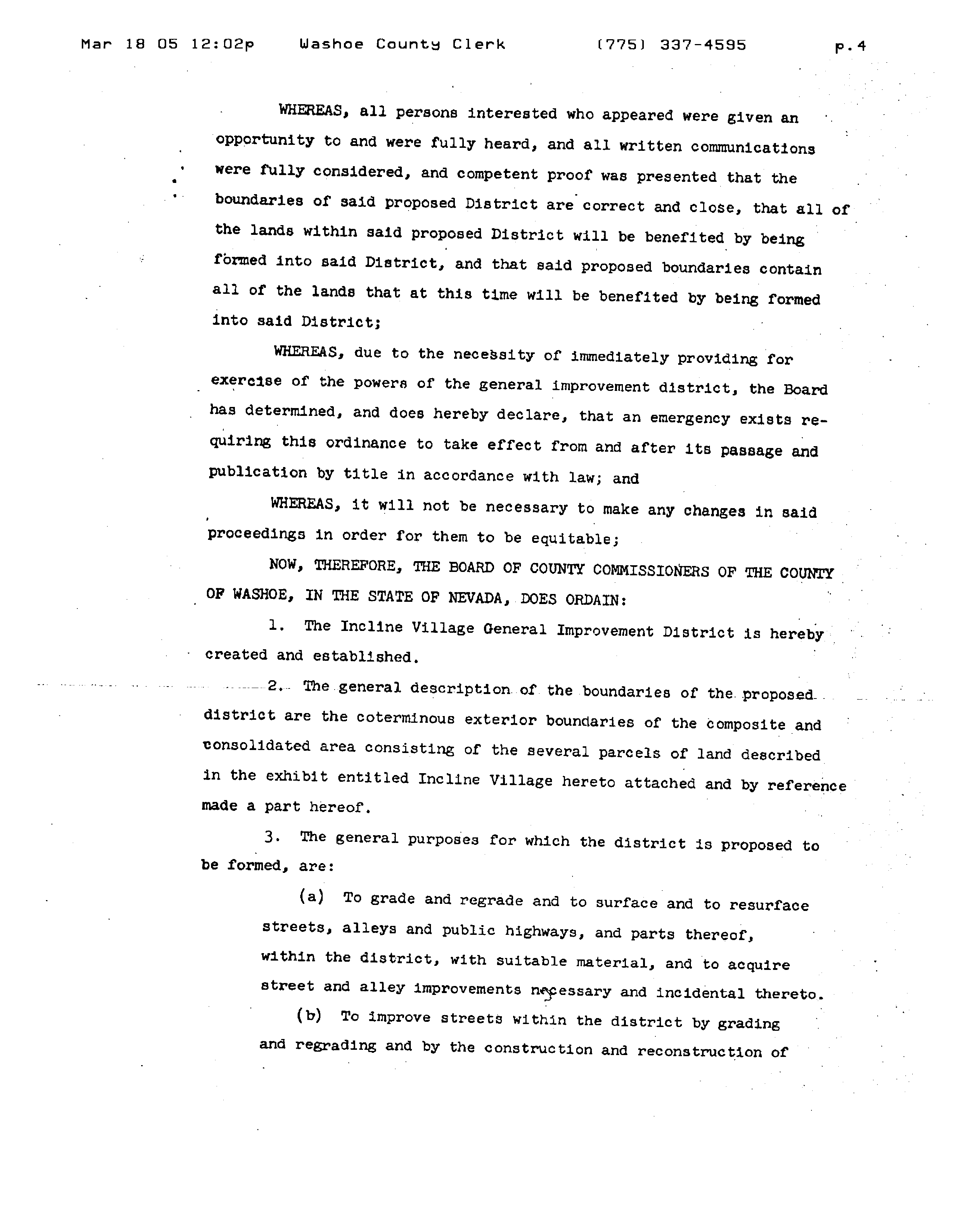
Yes we’re mindful the beach deed recites that the “Board of Trustees shall have authority to levy assessments and charges provided by law.” But is the BFF an assessment or charge provided by law? And if it is, is its payment a pre-condition to access and use of the beaches? For the reasons below, we say no.
Although the District tells the public, in part, that the BFF is a NRS 318.197 standby service charge for the availability to access and use beach facilities49, it is not an “assessment provided by law.” Because NRS 318.197(1) expressly states that GID Boards shall not have the power to “fix, and from time to time increase or decrease…special assessments.” Although NRS 318.350(1) allows GID Boards to specially assess:
“Lands and premises abutting upon that part of the street or alley so improved or proposed so to be, or the lands abutting upon the improvement and the other lands as in the opinion of the board may be specially benefited by (an) improvement,”
the enabling statutory grant is not NRS 318.197(1). And given few local resident parcels actually abut the District’s beaches, we submit no authority exists to formally assess parcel owners.
Nor is the BFF a “charge provided by law.” Because NRS 318.015(2) instructs that:
“As a matter of legislative determination…it is hereby…declared that the provisions of this chapter are not intended to provide a method for financing the costs of developing private property.”
Given for decades the District, past trustees and members of the public have described the beaches as private property, NRS 318.197 standby service charges cannot be adopted nor used to finance the costs of developing the beaches.
For these reasons, combined with our discussion below insofar as Special Revenue Fund reporting, the District admits these “fees” are “imposed nonexchange revenues, which result from assessments…other than (those)on exchange transactions.”50 In other words, the product of nonexchange transactions. Given the District represents that the RFF/BFF are standby service charges, by definition this means they are the product of exchange transactions, yet here the District admits the RFF/BFF are the product of nonexchange transactions, this admission is evidence the RFF/BFF are really not the monetary exactions staff and past Boards have represented.
Admission No. 11. Former Auditor DavisFarr Has Admitted The RFF/BFF Are The Product of Nonexchange Transactions: The question over the distinction between exchange versus nonexchange transactions reared its ugly head at the District’s December 8, 2021 Audit Committee meeting51 insofar as the propriety of reporting the RFF/BFF as general revenues. Cliff Dobler, a member of the Committee at the time, questioned the propriety of staff’s proposed “change in net position” labeling52 insofar as the District’s proposed 2021 ACFR were concerned. Mr. Dobler commented as follows:
This labeling is “really quite amazing (insofar as)…the…facility fee being considered ‘general revenue’ (is concerned)…given the resolution the Board adopts each year which assesses the RFF/BFF”53 recites that “the (RFF/BFF are) charges for services.” Mr. Dobler questioned why (here these “fees”) were reported as “general revenues” if they were really charges for services54? After all, page 22 of GASB Statement No. 9 instructs they are not properly reported as “operating revenues.”
Surprisingly, both Finance Director Paul Navazio and Auditor Jennifer Farr55 responded by pointing to the distinction between exchange and nonexchange transactions “regardless of the terminology.” Ms. Farr instructed as follows:
“For something to be (a) charge…for services it has to be an exchange transaction…By (its) nature (the RFF/BFF are)…not…If you pay a fee to golf, that’s an exchange transaction. You’re paying a fee for a direct ‘something’ that is given to you. (In contrast) an assessment (such as the RFF/BFF) is never going to be an exchange transaction….Because (these fees are not the product of) an exchange transaction…(Thus for these reasons, Ms. Farr opined that facility fee revenue was) properly (reported) in th(e general revenue) category. (Moreover, and as additional evidence in support of her position, Ms. Farr referenced with agreement the opinion of) our prior auditors [see the auditor EideBailly admission discussion below] (who) agreed with this assessment as well.”56
Given the District represents that the RFF/BFF are standby service charges, by definition this means they are the product of exchange transactions, yet here the District’ ‘s former auditor DavisFarr admits the RFF/BFF are the product of nonexchange transactions, this admission is evidence the RFF/BFF are really not the monetary exactions staff and past Boards have represented.
Admission No. 12. Former Finance Director Paul Navazio Has Admitted The RFF/BFF Are The Product of Nonexchange Transactions And in Essence Taxes: At the District’s same December 8, 2021 Audit Committee meeting38 former Finance Director Navazio responded to Mr. Dobler’s general revenue question as follows:
The RFF/BFF were properly reported as “General Fund revenues…(specifically because they were not) generated by the activities of our (recreational) venues like…charge(s) for service(s such as)…skiing or golfing…(Because) these (charges)…(we)re not tied to use of the venues57…(and they we)re collected and assessed from property owners…they…(we)re properly reported where they (we)re”58 as general revenues. The key to him was that the RFF/BFF are “considered…non-exchange transaction(s)…(because) under the NRS, if there (i)sn’t a (special) benefit we (can)not be assessing the recreation fee…(The RFF/BFF are) not the same as somebody paying for…services.” If that were the case, “we would not be allowed to charge the fee (because)…that’s a tax.”59
Wow! What both Mr. Navazio and Ms. Farr were admitting at the subject Audit Committee Meeting was that because the RFF/BFF are not generated through exchange activities, they are taxes. And as such, they were properly reported as general revenues. Given the District represents that the RFF/BFF are standby service charges, by definition this means they are the product of exchange transactions, yet here the District’ ‘s former Finance Director admits the RFF/BFF are the product of nonexchange transactions, this admission is evidence the RFF/BFF are really not the monetary exactions staff and past Boards have represented.
Admission No. 13. Former Auditor EideBailly Has Admitted The RFF/BFF Are The Product of Nonexchange Transactions And in Essence Taxes: It’s not just the District which has repeatedly admitted in its ACFRs that the RFF/BFF are the product of nonexchange transactions and thus taxes. Nor previous auditor Jennifer Farr and previous Finance Director Paul Navazio. Another one of the District’s previous auditors, EideBailly, has made the same kinds of admissions. On December 16, 2015, testifying before the IVGID Board’s Audit Committee, Dan Carter (an EideBailly Audit Engagement Partner) testified60 as follows:
“There is specific guidance in GASB about what can and cannot be accounted for in a Special Revenue Fund…GASB (i)s trying to put in some pretty strict guidance insofar as when a Special Revenue Fund can be used…It is unusual up here (Incline Village) when we use the word ‘fee,’ like the Community Services Fee or the Beach Fee, (be)cause actually, technically it is a tax…So the fact there’s a restriction on the use of that tax money61 is exactly what a Special Revenue fund is used for.”
Wow! After making this tax versus fee admission, understandably, staff and the then Board went into full damage control. After all, they couldn’t continue to legitimately promote their involuntarily RFF/BFF levy if those “fees” were invalid taxes. Right? So on May 23, 2016, in a memo to the Chairman of the Audit Committee, relying upon the distinction between exchange and nonexchange transactions, Mr. Carter attempted to “clarify” his prior December 16, 2015 testimony:
“Enterprise Fund accounting is primarily used when exchange fees (for example, the fee to play a round of golf financially) support (enterprise)…fund(s). Special Revenue Fund accounting on the other hand, is used when imposed nonexchange fees [‘for example, property tax or other assessment(s)’]…result from assessments (here levies) imposed by governments on individuals.” Because the payor(s) of these fees receive nothing of value in return, Mr. Carter admitted again (seemingly unaware of the real reason for his being requested to draft a follow-up memo) that “classification…may be more appropriately accounted for in…Special Revenue Fund(s).”
Wow again! But because of the nature of Special Revenue Funds and nonexchange transactions, this testimony by EideBailly represents another admission that the “primary purpose” of the RFF/BFF differ from the monetary exactions staff and past Boards have represented. And again, making them invalid taxes68.
Admission No. 14. Consultant MossAdams Has Admitted The RFF/BFF Are The Product of Nonexchange Transactions: In 2020 accountancy consultant MossAdams62 was engaged to review the District’s Punch Card Accounting and to provide a report summarizing its observations and recommendations. During this engagement, review was expanded to incorporate how annual Facility Fees should be properly classified and reported in the District’s financial statements. Given “the historic issue and disagreement between IVGID management and citizens has been whether the (District’s) Facility Fees are (the product of) exchange or nonexchange transactions,” MossAdams concluded as follows:
“The District’s Facility ‘Fees’ are the product of a non-exchange transaction under guidance provided in GASB Statement No 33 which generally provides for asset recognition when a resource is received or at the time a legal right to resources exist, and revenues recognized when all eligibility criteria are met securing the entity’s (here IVGID’s) right to the resource63. Since the Facility Fee is collected by Washoe County, secured by liens on property, and no requirement is placed on IVGID’s right to use the…Fees…the(y)…are deemed to be (the product of) non-exchange transactions.”64
Given the District represents that the RFF/BFF are standby service charges, by definition this means they are the product of exchange transactions, yet here the District’ ‘s consultant MossAdams admits the RFF/BFF are the product of nonexchange transactions, this admission is evidence the RFF/BFF are really not the monetary exactions staff and past Boards have represented.
Admission No. 15. The Effect of Staff’s Refusal to Implement MossAdams‘Special Revenue Fund Modifications: At the District’s Audit Committee’s June 1, 2022 meeting, in response to MossAdams‘ conclusions, District Staff announced they disagreed and for this reason refused to implement the changes suggested (financial reporting in enterprise rather than special revenue funds). Which harkens us back to the May 2, 2022 written comments (below) submitted by local resident John Ciacchella65 to the IVGID Board at its May 11, 2022 meeting66:
“Back in late 2020/early 2021 MossAdams made specific recommendations to the Audit Committee…Th(os)e recommendations were presented and accepted…The Audit Committee then sent these recommendations to the Board of Trustees where the Board accepted all the recommendations made…IVGID Management was then instructed…to adopt all of the recommendations…Not only ha(ve) IVGID Management failed to implement all (of) the MossAdams’ recommendations…IVGID Management (on their own) decided to hire…an outside auditor (DavisFarr)…at additional cost to IVGID…to review and comment on the Moss Adams recommendations and the direction…received (from) the Board…IVGID Management was not asked to secure this ‘second opinion’ and further has failed to follow all (of) the recommendations as instructed by the Board of Trustees. The Board needs to hold IVGID Management accountable (and) to follow…through on its instruction to (staff)…Not doing so is exposing the IVGID community to downstream financial risks and is not being transparent with the community on the true financial state of IVGID. Not to mention this is also a breakdown in governance between the Board of Trustees and IVGID management…Sincerely, John Ciacchella, Retired Partner – Deloitte.”
Wow! This kind of says it all, doesn’t it? Exactly who is driving this bus we know as IVGID? And regardless, MossAdams‘ conclusions and staff’s refusal to implement them represent admissions by means of of conduct that the RFF/BFF are not the monetary exactions they and past Boards have represented.
The Change in Financial Reporting of The Community Services And Beach Funds From Enterprise to Special Revenue67: Until fiscal year 2016 the District’s Community Services68 and Beach69 Funds were both designated as Enterprise Funds70. Yet at the Board’s May 21, 2015 meeting71, it adopted Resolution No. 1838 which formally converted “the (District’s)…Community Services and Beach (Enterprise) Funds (to)…Special Revenue72, (Special Revenue) Capital Projects and (Special Revenue) Debt Service funds.” In other words, a change from Proprietary to Governmental Funds. This change had particular relevance because where a government’s financial reporting incorporates special revenue funds, there’s an implicit admission that the activities which generate revenue in those funds are “taxes, intergovernmental revenues, and other non-exchange revenues.”73 Moreover, there is a core requirement that the revenues in those funds must be designated for specific, non-capital, non-debt service activities74. These requirements have been applied in the State of Nevada at page 2 of Nevada Department of Taxation’s Guidance Letter 15-002 which instructs that:
“Based on the definitions of Proprietary Fund75…in NRS 354.553 and…Special Revenue Fund found (in) 354.57076, as well as GASB Statement No. 3477, a Special Revenue Fund is a type of Governmental Fund, whereas an enterprise fund is a type of Proprietary Fund…A Governmental Fund, such as a Special Revenue Fund, generally has activities which are financed through taxes, intergovernmental revenues, and other non-exchange revenues.”
As well as GASB Statement No. 3378 which instructs that:
“In order to qualify for Special Revenue Fund accounting a substantial portion of the fund’s revenues must come from nonexchange transactions…involving financial or capital resources” (for example, most taxes, grants, and private donations).
Although staff misrepresented to a largely ignorant Board that the aforesaid fund conversions would
“Result in…more disclosure of functional level expenditures (and)…clarity…from producing schedules based on sources and uses,”79
Their real purpose was nothing short of circumventing the protective enterprise fund transfer provisions of NRS 354.613(1)80. And that’s exactly what occurred after passage of this resolution! Paving the way for the massive increase [over 350% in ten (10) short years] in alleged central services cost transfers81 from the District’s Community Services, Beach and Utility Funds to its General Fund. The net result of which was to massively increase [by nearly 680% in ten (10) short years] the General Fund balance from $886,664 on July 1, 2014 to $6,013,261 on June 30, 202382.
What we describe as nothing short of a de facto “slush fund” available to be spent on future unidentified, unbudgeted, and unappropriated pet projects (such as a new Administration Building financed by the RFF/BFF for a facility which has nothing to do with the availability of furnishing public recreation facilities).
Staff didn’t realize it at the time (unintended consequences). But because of the nature of Special Revenue Funds, changing these fund types represents another admission (by means of conduct) that the “primary purpose” of the RFF/BFF which funded these massive General Fund balance increases differed from the monetary exactions staff and past Boards have represented. And making them invalid taxes83 the subject of non-exchange transactions.
Admission No. 17. They Pay For Alleged Benefits to People: rather than property. As elsewhere stated,
“Each year (the District’s Board)…establishes…annual Recreation…and Beach Facility Fee(s)…As part of the annual budget process the Board traditionally approves a resolution84 which…establish(es) the amount of the…RFF and…BFF to be collected.”85 In accordance with NRS 318.201(1), that resolution “finds that the availability of the use of IVGID’s beaches; boat launch ramp; Championship golf course; Mountain golf course; tennis facilities; the Chateau and Aspen Grove; Diamond Peak Ski Resort, and Recreation Center86, including reduced rates for season passes and reduced daily rates, are all benefits which inure to the owners of properties (i.e., people) assessed hereunder.”87 Therefore, it is: “the owners of the parcels (i.e., people) set forth (t)herein (which) are (the ones) directly benefited;”88 and, “Ordinance No. 7 sets forth in detail the specifics of the benefits available to property owners (again people) of all properties.”89
Similarly, ¶690 of that resolution46 adopts:
“A written ‘Report’91 (for collection on the county tax roll which describes those charges as)…Recreation Standby and Service Charges [also known as the Recreation…and Beach Facility Fee(s)]…for (persons’)…availability of use of the recreational facilities (therein) described.”92
And if this weren’t sufficient, the District maintains an “IVGID Facility Fee FAQ” page where it asks the question: “what benefits do I get from these fees?” Listen to the answer:
“IVGID beach access and (user fee) discounts at IVGID-run venues and programs…Check out the programs and admission rates on our website and you will often see a discounted rate for IVGID Picture Pass holders” (i.e., persons).
But as we’ve elsewhere explained, “standby service charges” represent…(a) monetary levy for a direct special93 benefit furnished to real property94. And since each year the District elects to collect the RFF/BFF against real property pursuant to the authority of NRS 318.20195, it in essence admits96 by means of conduct that for the RFF/BFF to be legitimate standby service charges, their purpose must be to recover the costs the District incurs for the availability of services and facilities furnished to real property. Which would make sense if they were legitimate standby service charges inasmuch as NRS 318.197(3) further instructs that,
“The board shall prescribe and enforce regulations for the (physical) connection (to property) with and the disconnection from properties of the facilities of the district and the taking of its services.”97
But that’s not the case here. There are no regulations for connecting and disconnecting the District’s beaches and public recreation facilities to those local parcels which are assessed the RFF/BFF. Because parcels of real property are incapable of accessing and using recreation facilities. Rather, people are. Meaning this conduct represents another admission the RFF/BFF cannot be the “recreation (and beach) standby…charges…for the availability of use of the…beaches (and the District’s public)…recreational facilities” staff and past Boards have represented.
Admission No. 18. They Pay For The Equivalent of Up to Five (5) Membership Cards: which entitle the bearer [i.e., PPHs (persons rather than properties] to preferred access to and pricing at the District’s public recreation and beach facilities. For years staff have accompanied the District’s final budgets with a letter addressed to “the Board of Trustees and Citizens of Incline Village and Crystal Bay.”98 Many of those letters have expressly asked and answered, in part: “What Privileges…Parcel Owners Get For Paying…Facility Fees?” Let us quote from a portion of the letter which accompanied and appears at page 16 of the 2018-19 Budget:
“Each eligible parcel that pays the (RFF) can have five (5) cards issued in the form of picture passes…and/or punch cards…or a combination of both. The Picture Passholder (“PPH”) [again person] gets preferred pricing and/or preferred access to the District’s major (recreation) venues or programming…A Punch Card Holder receives the opportunity, at designated (recreation) venues, to reduce their user fees from the (retail) rack rate to the (preferred) PPH rate.”
Once members of the public learned of this admission and publicized it as evidence the RFF/BFF are “taxes,” uncoincidentally, this admission disappeared. Yet unbelievably, it in essence has returned on the District’s web site under its “IVGID Facility Fee FAQ” page. Where the reader asks the question: “what benefits do I get from these fees?” Listen to the answer:
“Each parcel and dwelling unit that is assessed an IVIGD Facility Fee is eligible to receive a combination of IVGID Recreation Passes and Recreation Punch Cards, totaling five (5), as suits their personal needs. These cards are paid for with the annual Recreation and Beach Facility Fees that are reflected on your Washoe County tax bill. IVGID Recreation Passes and Recreation Punch Cards allow the holder to pay a reduced rate at all IVGID facilities and provide access to the restricted-access IVGID Beaches.”
In other words, past staff with the ratification of past/current Boards have admitted that the RFF/BFF pay for nothing more than up to five (5) membership cards similar to those sold by Costco, Sam’s Club, Prime, Best Buy Plus99 and now Walmart Plus100 which provide preferred access, pricing and other benefits to cardholders (again, people). But given those recreation venues (but for the beaches) are just as “available” to be accessed and used by any person, whether or not a resident of Incline Village/Crystal Bay, a local parcel owner, or someone else who pays the RFF/BFF, here IVGID staff and the Board have admitted the RFF/BFF do not pay for the mere availability to access and use the District’s public recreation and beach facilities as they have represented. Rather, they pay for a handful of plastic membership cards most parcel owners we know (i.e., persons) don’t want!
Admission No. 19. Which Provide Preferred Access to And Reduced Pricing at The District‘s Public Recreation Facilities: In addition to the above-admissions in past budgets and the District’s IVGID Facility Fee FAQ web page, listen to ¶4(b) of the resolution46 the Board adopts each year which fixes the RFF/BFF:
“The Board of Trustees finds that each parcel assessed pursuant to this Resolution and in its report for the collection on the Washoe County tax roll…is specifically benefited as follows…reduced rates for season passes and reduced daily rates…which inure to the owners of properties (i.e., people) assessed hereunder.”
And ¶4(b) of that resolution46 which instructs “Ordinance No. 7 sets forth in detail the specifics of the benefits available to property owners (i.e., people) of all properties.” So let’s go to ¶64 at page 18 of Ordinance No. 7:
“An IVGID Recreation Pass…provides the Pass Holder (i.e., person with)…reduced (i.e., discounted) season pass rates, at District-owned ski, and tennis facilities; and reduced (i.e., discounted) daily rates at District-owned golf, ski and tennis facilities; and reduced (i.e., discounted) yearly, quarterly, monthly, or weekly membership rates at District-owned Recreation Center; and reduced (i.e., discounted) rates on various recreation programs and services reduced (i.e., discounted) daily rates at the District-owned Recreation Center; and reduced (i.e., discounted) rates for the rental of the Chateau, Aspen Grove Community Building, Diamond Peak Ski Lodge, Recreation Center, and District owned athletic fields; and watercraft launching access at the District-owned watercraft ramp to Pass Holders with Beach Access…and any other Recreation Privileges determined by the Board.”
Let’s go to ¶81 at page 24 of Ordinance No. 7:
“A Recreation Punch Card provides the Pass Holder (i.e., person) with a face value of Recreation Privileges, determined by the Board, which may be applied (to)…the Guest rate for daily Beach Access, daily watercraft and jet ski launching; and the difference (i.e., discount) between the Pass Holder rate and the non-Pass Holder (i.e., retail) rate for daily access to the District-owned golf, ski, recreation center, and tennis facilities; and the difference (i.e., discount) between the Pass Holder rate and the non-Pass Holder (i.e., retail) rate for any other recreation use fee or rental fee as may be determined by the Board.”
So here again we see that IVGID staff and the Board have admitted the RFF/BFF do not pay for the mere availability to access and use the District’s public recreation and beach facilities as they have represented. Rather, they pay for alleged user fee discounts at the District’s public recreation facilities once a PPH (i.e., a person) actually chooses to visit one or more of those facilities, and pay the additional user fee(s) assessed thereat.
Admission No. 20. They Have Been Used to Pay For Up to Five (5)Pre–Loaded Debit101/Gift Cards: capable of paying down all or a portion of user fees charged at IVGID’s beaches and select public recreation venues. In other words, picture passes and punch cards have been used not just as membership cards which provide preferred access and discounted pricing (see discussion above), but as debit cards with some pre-loaded value. As we’ve demonstrated above, by design (see ¶81 at page 24 of Ordinance No. 7), punch cards provide PPHs (i.e., persons) with a “value” equivalent to the difference (i.e., the so called discount) between the PPH rate and the non-PPH (i.e., retail) rate for daily access to the District-owned golf, ski, recreation and tennis facilities, and other recreation use or rental fees as may be determined by the Board. And then in 2017, the District changed the way punch cards could be used. They were converted into pre-loaded debit or gift cards where the user fee at targeted recreation facilities could be paid down to a lower than preferred PPH rate based upon the pre-loaded “value” of the card102, or multiple cards103. Just listen:
“This spring promotion…allow(s) residents to use the remaining value of their…expiring Punch Card(s) towards the purchase of a Mountain Course Play Pass…(Initially) each $1 of expiring Punch Card value c(an) be applied as a $0.50 credit” towards the purchase price of a play pass.
In 2018 this promotion was extended to “Incline Village Tennis Center Season Membership Pass(es)” with the restriction each $1 of expiring Punch Card value could be applied as a $0.35 credit towards the purchase price of a membership pass. Although this promotion ended in 2019, in 2023 our GM at the time attempted to resurrect it104.
The point here being that this behavior is an admission, again, that the RFF does not pay for the mere availability to the District’s public recreation facilities as staff and past Board members have represented. Rather, it can and in the past has paid (in other words, the mold has been cast) for the equivalent of one or more debit or gift cards whose expiring “value(s)” can be redeemed for comparably valued facility use and/or services once a PPH (i.e., a person) actually chooses to visit one or more of those facilities, and pay the additional user fee(s) assessed thereat.
Admission No. 21. Favored Collaborators‘ Local Parcels Are Exempted From Payment Notwithstanding They‘re Beneficiaries of The Same Facilities And Services as Every Other Local Parcel Which is Involuntarily Assessed: Think about it for a moment. The District provides public water and sewer services to all parcels in Incline Village/Crystal Bay. Including those owned by the District or any number of their favored collaborators105. Ditto the solid waste disposal services the District contracts with Waste Management to furnish. And the sewer services Reno, Sparks and Washoe County furnish. And the electricity and natural gas NV Energy and Southwest Gas furnish. And the water Truckee Meadows Water Authority furnishes. And the building permit fees Washoe and Douglas Counties charge. And permit fees TRPA charges. And all of these beneficiaries are charged the same fees as every other class of customer is charged. No exemptions!
So assuming the RFF/BFF are legitimate fees (for the availability of facilities and services the District represents), where does the District get off exempting anyone from payment, including itself? Let’s examine NRS 318. Although NRS 318.197(1) gives the District the power to fix and change the rates, tolls and charges it assesses, where does it give the power to exempt anyone (including itself) from payment where facilities and services are furnished? After all, doesn’t Dillon’s Rule106 instruct that as applied to local government, the only powers its governing board may are:
(a) Those…granted in express terms by the Nevada Constitution or statute;
(b) Those…necessarily or fairly implied in or incident to…powers expressly granted; and
(c) Those…essential to the accomplishment of the declared objects and purposes of the (local government) and not merely convenient but indispensable.”
And “if there is any fair or reasonable doubt concerning the existence of a power, that doubt is resolved against the (local government)…and the power is denied?”107
And as a limited purpose special district108, where does IVGID have the power to pass laws or legislate to fill the void the State Legislature arguably created when it adopted NRS 318? The answer is nowhere!
Yet when it comes to payment of a tax, the State has expressly provided for a number of exemptions109.
With the foregoing as a back drop, consider Board Policy No. 16.1.1.2.0.6 which declares that:
“Real property that is located within the current geographic boundaries of the District but which Washoe County has exempted from paying Washoe County property tax (is)…’Exempt Real Property’…Exempt Real Property includes but is not limited to, real property that is used or intended for use for religious or educational purposes, condominium and town house common areas that do not include any Dwelling Units, and publicly owned property.”
And ¶I(D) of the Report the Board adopts each year which fixes the RFF/BFF and elects to have them collected on the county tax roll91 declares that:
“Exceptions. “Lots, parcels and areas of land used, or the portions thereof used, or intended to be used, for religious…or educational purposes; common areas without occupied structures appurtenant to a condominium or townhouse cluster and publicly owned lands, are (all) excepted and excluded from the charges imposed by subsections A through C of this section. In addition, any parcel which is: (1) undeveloped, and (2) subject to a deed restriction, acceptable to IVGID staff, preventing any and all development of the parcel in perpetuity, which deed restriction is recorded in the Washoe County Recorder’s Office, and (3) whose owner agrees to waive in perpetuity on his own behalf as well as on behalf of his successors and assigns any right to demand in the future any recreation privileges arising from or associated with said parcel is also excepted and excluded from the charges imposed by subsections A through C of this section.”
We submit that the fact the District has applied ad valorem tax exemptions to the alleged beach and public recreation “fees” it assesses, is an admission the RFF/BFF are not the standby service charges staff and past Boards have repeatedly found and represented to the public they are.
Most Think They’re Taxes: On numerous occasions when budget matters have been discussed by the Board, staff (primarily the District’s former Finance Director, Gerry Eick) have given testimony to the effect that “most people think the RFF/BFF are taxes.” Knowing this is the way the public views the RFF/BFF, yet doing nothing to correct their thinking, staff and past Boards have been guilty of omitting material facts necessary to equip the public to understand the true nature of the RFF/BFF. Which only perpetuates the public’s mistaken views, and as far as we are concerned, represents deceit110. When you know most of the public thinks the RFF/BFF are taxes, and you do nothing to correct their views, in addition to deceit this constitutes an admission by means of conduct that you too think the RFF/BFF are taxes.
So whether it’s the RFF/BFF collection resolution46 the Board adopts each year, “Ordinance No. 7, Trustee Homan, or IVGID staff and the remainder of the Board, they all admit the RFF/BFF do not pay for the mere availability to access and use the District’s public recreation and beach facilities. Rather, they admit they pay for persons‘ preferential access and pricing to the District’s beach and public recreation facilities.
In other words, rather than being a legitimate standby service “fee,” the RFF is a “tax” because those (i.e., persons) whose properties are forced to pay receive nothing of value in return that all members of the general public don’t also receive. Stated differently, even though one of the earmarks of a legitimate user fee is a payor’s choice111 inasmuch as the charge is supposed to be “incident to a voluntary act,”112 here the payor has no choice whatsoever. Thus this fact is an admission by means of conduct that the Board has simply budgeted the RFF at a level sufficient to pay the costs associated with those venues where no user fee is assessed which are “available” for free use to the general public as a whole.
Most Treat Them as Taxes on Their Income Tax Returns: It’s not just Mr. Eick’s representations to the Board and the public which demonstrate he knows the public does not think of the RFF/BFF as “fees” (see the discussion above). Follow us closely on this one.
Many staff members (like Mr. Eick’s wife) and most Board members, own Incline Village or Crystal Bay properties which are assessed the BFF and/or RFF. Presumably they file, and in the past have filed, federal income tax returns. And presumably in the past, before President Trump’s income tax reforms, they claimed or even today claim itemized personal deductions on Schedule A of those returns, rather than the historically high standard deduction. One of the deductions available on Schedule A is ad valorem real estate taxes paid. Given “the County Treasurer…include(s) the (District’s BFF and/or RFF)…on bills for taxes levied against…lots and parcels of land,”113 what number (i.e., one which includes or omits the RFF/BFF) do you think they have inserted? Assuming it’s the number which includes the RFF/BFF (which we assume because everyone we know does this), haven’t they declared to the IRS that the RFF/BFF represent real estate taxes paid rather than simply “fees” the District’s resolutions represent38? And if so, haven’t they lied to the public by telling us the RFF/BFF represent “fees” rather than “taxes?”
The position of IVGID trustee is one in the nature of public trust114. Our trustees are our fiduciaries and “hold office for the sole benefit of the people.”115 Each has taken an oath of office whereby he/she has taken and subscribed to the official oath whereby he/she has “solemnly swear(ed or affirmed) that (he/she) will…bear true faith, allegiance and loyalty to the…United States and…the State of Nevada…and…any ordinance, resolution (such as No. 188932) or law of any state…so help (him/her) God (if an affirmation) under the pains and penalties of perjury.”116 Members of our community have gone on record asking staff and trustees to disclose whether they have deducted the RFF/BFF on their federal income tax returns? And as you might suspect, none has been willing to answer the question. Members of our community have even asked trustees to provide a redacted Schedule A to their personal federal income tax returns to reveal whether they have deducted IVGID taxes including the RFF/BFF paid. And again, none has been willing to provide the same. Now why is that? If you are itemizing deductions on your personal federal income tax return, deducting the RFF/BFF under the guise they represent “taxes,” and signing that return under penalty of perjury, while contemporaneously telling the public these exactions are really “fees,” we assert this represents an admission you really believe they are the former.
To those who criticize us because we have no direct evidence that a number of staff and past trustees are guilty of such conduct, we say you’ve got it backwards! The burden is upon you to prove us wrong! After all, when you’re a fiduciary117 and you’re charged with deceit or constructive fraud118, the victim “always satisf(ies) the standard of fraud”119 entitling him/her to demand the “shift(ing of)…the burden (of proof)…to the other party to negate some element of the prima facie case.”120 Translation: the burden is not on us to prove that past staff and trustees have declared the RFF/BFF to be taxes on their federal income tax returns.
The point here being that this behavior is an admission again that the RFF really does not pay for the mere availability to access and use the District’s public recreation facilities as staff and past/current Board members represent. Rather, it pays for the equivalent of one or more debit or gift cards whose expiring “value(s)” can be redeemed for comparably valued goods and/or services.
Moreover, They‘re Excessive, Unjust, And Unreasonable: As we’ve elsewhere explained,
“Standby service charges” represent, in part, some sort of monetary levy which recoups the costs government actually incurs to make services addressing public health and sanitation98 available to those properties which are assessed97. “The only (limitation on the power to fix such charges) is that such rates be (just121 and) reasonable.”122 In other words: amounts which are allocated directly to defraying the costs of providing the furnished service; and…reasonably proportionate to the benefit received123. Because “[i]f the ‘fee’ unreasonably exceeds the value of the specific services for which it is charged[,] it will be held (to be) invalid” as something other than a fee (like a tax124).
Here the RFF/BFF are “excessive and unreasonable in that (they) provide revenue substantially in excess of that needed (to make the District’s beach and public recreation facilities available to be accessed and used by those parcels which are assessed81. So)…profits (can be)…transferred out of the (Community Services and Beach) Funds (and) into the General Fund”125 through the artifice of central services cost transfers. After all, “such practice is unlawful under the (California) Supreme Court’s decision in City of Madera v. Black, 181 Cal. 306, 314, 184 P. 397 (1919) wherein the court held that a city had no power to operate sewers for the purpose of (generat)ing revenue or profit therefrom.”104 And it is probably unlawful in Nevada103 as well. If not, it certainly violates Article 4, Section 20 of the Nevada Constitution according to the Nevada Supreme Court’s decision in Clean Water Coalition, supra, at 255 P.3d 259126. So the question: Are the RFF/BFF used to generate revenues in excess of those required to make the District’s beach and public recreation facilities available to those parcels which are assessed? We believe the answer is yes.
As we’ve elsewhere demonstrated, the RFF/BFF represent far more than the just and reasonable amounts necessary to make the District’s beaches and public recreation facilities merely available to be accessed and used by those whose parcels are involuntarily assessed. Where have staff and past Boards ever shared with the public those amounts? Instead, haven’t we demonstrated that “the RFF/BFF represent nothing more than the difference betwin Clean Water Coalition, supra, at 255 P.3d 259een budgeted revenues and intentional overspending assigned by staff to the Community Services (insofar as the RFF is concerned) and Beach (insofar as the BFF is concerned) Funds, respectively?” In fact, haven’t we demonstrated that they represent 120% or more of those amounts because of the intentional build up of “slush funds” in both of these Funds? In other words, rather than compensating for the actual cost of recreation/beach facilities the District allegedly furnishes3, the RFF/BFF primarily represent additional revenue sources intended to pay for subsequently budgeted overspending! Making neither a fee28.
Given the definition of standby service charges, and the fact staff and past Boards have used the RFF/BFF as a vehicle to generate revenues for purposes other than the mere availability of beach and public recreation facilities, they have admitted (based upon their conduct) these exactions are not the standby service charges they represent3.
And They Lack Proportionality: Even where a PPH or Punch Card holder is able to realize “preferred pricing” at a District public recreation facility, in many instances that preference is de minimis. Two simple examples prove the point: Daily adult membership rates at the Rec Center stand at $18. But if one presents a PPH or Punch Card, the rate can be reduced by a whopping $4 (22.2%) to $14. Daily adult court reservation fees at the Tennis Center also stand at $18. But if one presents a PPH or Punch Card, the rate can be reduced by $3 (16.67%) to $15. The RFF (which currently stands at $450127) is nowhere proportionate in amount compared to the de minimis preference in pricing benefit allegedly available at these two recreation facilities!
Rather than addressing the RFF’s/BFF’s “proportional and reasonable” amounts, listen how past Boards have addressed the proportionate prong of the Emerson College test:
“The rates charged for natural, intrinsic and fundamental distinctions are reasonable in their relation to the object of the charges imposed…and that said charges have been apportioned in relation to said natural, intrinsic, fundamental and reasonable distinctions among said rates.”128 What?
Given all fees must be “reasonably proportionate (in amount compared) to the benefits received,”102 and here we’ve demonstrated the RFF/BFF are not (rather, they allegedly “are reasonable in their relation t the object of the charges imposed”), staff and past Boards have admitted (based upon their conduct) that these exactions are not the standby service charges they represent3.
They Pay For The District‘s Legal Costs: Before we address this subject, we feel the reader needs to understand the District’s revenue model. As elsewhere explained, for decades the District has budgeted to intentionally overspend129. The shortfall “required to (financially) support debt, capital expenditure(s) and operations for the District”130 has traditionally been covered by “service charges collected…for facility use and program activities,” higher than “just and reasonable” utility rates and charges131, and the RFF/BFF. Because the District is not a general government132 like a county, city or unincorporated town, it is restricted in the service charges it may legitimately assess. And given the marketplace dictates the service charges the District can realistically collect for facility use and program activities, the reality is that the greater the financial shortfall, the greater the reliance upon the RFF/BFF and utility rates and charges. Once this reality is understood, one begins to understand that essentially every expenditure which contributes to this financial shortfall is subsidized by the RFF/BFF133. And with this understanding firmly in mind, here we address one category of intentional overspending; legal fees.
The Wright and Kroll Lawsuits: Notwithstanding the District’s mantra of “one division – one team,” in 2007 two Crystal Bay residents (Frank Wright and Steve Kroll) sued the District over their non-access to its beaches. On May 14, 2007 when the Board adopted the BFF for fiscal year 2007-08, it voted to assess local parcel owners with beach access a $25/parcel fee to create a “beach access legal defense fund.”134 Given this charge had nothing to do with the costs the District was budgeted to incur to make beach facilities available for access and use by those parcels which were assessed, and it represented a “revenue measure” and a tax rather than a “fee.”135 By admitting the purpose of this portion of the 2007 BFF was primarily intended as a revenue measure for legal fees, the Board in essence admitted the BFF did not pay for the availability to access and use the District’s beach facilities. As represented3. And to further demonstrate this levy was a disingenuous revenue measure, after assessing local parcel owners the District made claim to its insurance carrier the the Pool Pact136 for a legal defense, and paid a $5,000 deductible. Did the District share these facts with the public? Did it refund this unnecessary levy to those parcel owners whose properties were involuntarily assessed? Of course not!
The Katz Litigation: Let’s move on to 2011 and local resident Aaron Katz. On August 12, 2011 Mr. Katz brought suit against IVGID advancing a number of theories: challenging the validity of the RFF/BFF under Nevada’s Uniform Declaratory Judgment Act137; setting aside various Board resolutions138 providing for allegedly preferential, discriminatory, unjust and unreasonable56 water and sewer rates; construing local parcel owners’ with beach access rights, status or other legal relations under the the beach deed62; removing IVGID as local parcel owners’ beach steward and fiduciary139 because of its breach of trust140; and, concealing public records141. Although initially the Pool Pact provided a legal defense to Katz’s claims under a reservation of rights142, early on it withdrew that defense because Katz was not seeking money damages against anyone. And there began a journey lasting some nine (9) years, culminating in an unsuccessful appeal of the Pool Pact‘s decision to not pay for the District’s legal defense, a judgment in favor of the District against Katz, two (2) appeals to the Nevada Supreme Court, and a petition seeking certiorari143 to the United States Supreme Court. All told, an expenditure of well in excess of $650,000 of local parcel owners’ RFF/BFF144!
The Lyons Litigation: Let’s move on to 2016 and local resident Kevin Lyons. “In 2016 IVGID contracted with (Mr. Lyons’) Governance Sciences Group Inc. (‘GSGI’), the creator of FlashVote, to conduct a series of scientific surveys on important IVGID community issues. Incline Village/Crystal Bay parcel owners and residents interested in participating were invited to contact FlashVote and were assured that their responses would remain anonymous to IVGID and their personal data would be private. Before year-end, there was a disagreement on how questions should be asked and GSGI terminated the contract…In April of 2017…(Chair Kendra) Wong convened a secret, closed-session meeting to discuss taking legal action against GSGI…Shortly thereafter a lawsuit was filed by IVGID against GSGI demanding that the citizen database be turned over to IVGID.”145 GSCI responded on September 7, 2017 with its own cross-action against IVGID146. On March 9, 2018 both parties “participated in a confidential settlement conference with assigned settlement judge, Debbie Leonard, Esq…During the confidential settlement conference, the parties reached a mutual compromise, resolution and settlement of all issues (raised or)…which could have been raised…arising out of, or related to the Litigation.”63 That resolution and settlement of the litigation was approved by the Board at its March 28, 2018 meeting. Simply stated, each party bore its own attorney’s fees and costs, and in addition thereto, IVGID agreed to make a $10,000 donation to the Incline High School “We the People” program on GSCI’s behalf147.
Since this was litigation initiated by IVGID, there was no Pool Pact coverage to pay the District’s litigation expenses. So how much did this endeavor cost local parcel owners? Unlike the Mark Smith litigation (see below), we can’t share a total number. However it appears that cost with attorney Guinasso was well in excess of $40,000.
The Smith Litigation: Let’s move on to 2018 and local resident Mark Smith. “On October 19, 2017…Mr. Smith made a (public) records request asking for (a series of)…District…communications (13,000+) for a twenty-two (22) month period beginning January 1, 2016 and ending October 19, 2017…(The District responded that) all but 304…were privileged and confidential…Mr. Smith disagreed…and filed a lawsuit on July 30, 2018 naming (the District,) IVGID Board Chair Kendra Wong, and District Counsel (Jason Guinasso) as defendants (and)…costing himself and the District tens of thousands of dollars148…As a consequence…the District was forced to retain outside legal counsel…(But) the Pool Pact declined to provide coverage (claiming)…there (wa)s no coverage…under the Nevada Public Records Act…After six months of litigation…the…Court…entered an order granting summary judgment in favor of Mr. Smith.”149 Eventually at the Board’s June 29,2022 meeting members agreed to pay Mr. Smith $77,457.85 to settle his lawsuit150.
At the Board’s September 28, 2022 meeting the full extent of the District’s legal defense costs were revealed; an unbelievable $236,938.88 plus a final payment to Mr. Beko of $18,293.87151! Therefore including the settlement payment to Mr. Smith, local parcel owners were compelled to involuntarily pay152 a grand total of $332,690.60 for staff’s concealment of public records. And this sum didn’t even include the many tens of thousands of dollars of unreimbursed staff time!
Conclusion: Because in each of these examples there was no other source of funds to pay for these litigation/defense costs other than the RFF/BFF, the District’s conduct represents another admission (by means of conduct) that the RFF/BFF do not pay for the mere availability to access and use the District’s beach and public recreation facilities, as represented3.
They Pay For All Sorts of Other Overspending: having nothing to do with the availability to access and use the District’s beach and public recreation facilities, as represented3. How about the District’s annual audit mandated153 of all local governments154? How about the hiring of lobbyists to influence statewide legislation? How about replacing the loss of annual real property tax revenue offset by Washoe County to pay for court mandated refunds due local parcel owners as a result of the State v. Bakst, 122 Nev. 1403, 148 P.3d 717 (2006) court decision155? How about membership in the League of Cities? How about membership in the North Lake Tahoe Chamber of Commerce? Or the Incline Village Crystal Bay Community and Business Association? Or the Bear League? How about building up a “slush fund” to pay for a new administrative building? We could go on-and-on but we hope we’ve made our point. The RFF/BFF pay for all sorts of expenditures having nothing to do with the availability to access and use the District’s beach and public recreation facilities.
Their Amounts Are Determined Before Budgeting to Overspend: It’s not so much that the RFF/BFF represent the shortfall between budgeted revenues and intentional overspending systemwide156. But rather, it’s that the Board first determines what the RFF/BFF will be, and only afterwards does it budget its overspending to a level which results in a balanced budget. Just listen to staff’s admission this is the process the Board goes through as a pre-cursor to adopting a budget:
“A significant component of the final…budget impacting the District’s Community Services and Beach funds is the adjustment to the Recreation…and Beach Facility Fee(s) assessed on property owners for the coming fiscal year.”157 Consistent with “Board of Trustees direction (which) has been provided to retain the combined Facility Fee at $780 for FY 2022-23158…the Recreation Facility Fee (was pre)set at $450, and (the) Beach Facility Fee (was pre)set at $330.”159
Given the above admission, how can anyone conclude that the primary purpose of the District’s BFF/RFF is for any reason other than raising revenue to balance the budget? Just like a tax rather than a NRS 318.197 standby service charge for the availability to access and use the District’s beach and public recreation facilities2.
Finally, as we’ve referenced above, letters addressed to “the Board of Trustees and Citizens of Incline Village and Crystal Bay” which used to accompany the District’s final budgets6 expressly answer the question of “What Privileges…Parcel Owners (rather than their parcels) Get For Paying…Facility Fees.”
Given the definition of a standby service charge, and the fact staff and past Boards have repeatedly found and represented to the public that the RFF/BFF pay for direct benefits furnished to people rather than property, they have admitted these exactions are really not the standby service charges they represent3.
Meaning The District‘s Use of NRS 318.201 to Collect is Improper: As stated above, “each year (when the District’s Board)…establishes…annual Recreation…and Beach Facility Fee(s it)…traditionally approves a resolution38…(which incorporates) a written ‘Report’ (which)…contain(s) a description of each parcel of real property (allegedly) receiving…services and facilities160 and the amount of the charge for each parcel for such year, computed in conformity with the charges prescribed by the resolution.” But since we’ve demonstrated the RFF/BFF pay for alleged benefits to persons rather than property, the District has in essence admitted the parcels of property assessed receive no services nor facilities and therefore, reliance upon NRS 318.201 is improper. Combined with the definition of a standby service charge, the District has again admitted the RFF/BFF are not the exactions they represent3.
They Pay For The Availability of Facilities Rather Than Services: As we’ve demonstrated above, according to staff and past Boards the RFF/BFF represent “recreation (and beach) standby…charges…for the availability of use of…recreational facilities…(therein) described.”3 But as we’ve elsewhere explained, standby service charges represent, in part, some sort of monetary levy for the availability and access to services161; namely, water and sewer services162. And let’s not forget there’s nothing in NRS 318.197(1) which recognizes standby service charges for the availability of facilities. Rather, it recognizes “standby service charges standby service charges…for the availability of service(s).”
Given the definition of a standby service charge, and the fact staff and past Boards have represented that the RFF continues even when those whose properties are assessed pay user fees at District owned public recreation venues where such fees are charged, they have again admitted these exactions are not the standby service charges they represent3.
They Do Not Terminate Once The Payors Become Actual Customers: Putting aside the fact the payors of the RFF/BFF are persons rather than their real properties which are assessed, as we’ve elsewhere explained,
“Standby service charges” disappear once those whose properties are assessed become actual District recreation customers. Because those recreation facilities, by definition, are no longer “standing by or immediately available to be connected to the propert(ies) to be benefited(. Instead they are) in fact (actually) providing the benefit.”97
But here staff and past Boards have admitted that those whose properties are assessed the RFF continue to be assessed even when they become actual District customers evidenced by their paying user fees at District owned recreation venues where user fees are charged163, regardless of whether the RFF is paid. The IVGID Board has adopted a “Recreation Roll Policy” (see ¶1.0 of Policy No. 16.1.1) which instructs that “the Incline Village General Improvement District will charge the prescribed Recreation…and if applicable…Beach Fee, to all qualifying real properties” regardless of whether additional user fees are paid.[/efn_note]. In other words, the RFF doesn’t disappear. And because it doesn’t, and given the definition of a standby service charge, staff and past Boards have admitted (by means of conduct) that the RFF is not the standby service charge they have represented3.
Most Think They’re Taxes: On numerous occasions when budget matters have been discussed by the Board, staff (primarily the District’s former Finance Director, Gerry Eick) have given testimony to the effect that “most people think the RFF/BFF are taxes.” Knowing this is the way the public views the RFF/BFF, yet doing nothing to correct their thinking, staff and past Boards have been guilty of omitting material facts necessary to equip the public to understand the true nature of the RFF/BFF. Which only perpetuates the public’s mistaken views, and as far as we are concerned, represents deceit164. When you know most of the public thinks the RFF/BFF are taxes, and you do nothing to correct their views, in addition to deceit this constitutes an admission by means of conduct that you too think the RFF/BFF are taxes.
Most Treat Them as Taxes on Their Income Tax Returns: It’s not just Mr. Eick’s representations to the Board and the public which demonstrate he knows the public does not think of the RFF/BFF as “fees” (see the discussion above). Follow us closely on this one.
Many staff members (like Mr. Eick’s wife) and most Board members, own Incline Village or Crystal Bay properties which are assessed the BFF and/or RFF. Presumably they file, and in the past have filed, federal income tax returns. And presumably in the past, before President Trump’s income tax reforms, they claimed or even today claim itemized personal deductions on Schedule A of those returns, rather than the historically high standard deduction. One of the deductions available on Schedule A is ad valorem real estate taxes paid. Given “the County Treasurer…include(s) the (District’s BFF and/or RFF)…on bills for taxes levied against…lots and parcels of land,”165 what number (i.e., one which includes or omits the RFF/BFF) do you think they have inserted? Assuming it’s the number which includes the RFF/BFF (which we assume because everyone we know does this), haven’t they declared to the IRS that the RFF/BFF represent real estate taxes paid rather than simply “fees” the District’s resolutions represent38? And if so, haven’t they lied to the public by telling us the RFF/BFF represent “fees” rather than “taxes?”
The position of IVGID trustee is one in the nature of public trust166. Our trustees are our fiduciaries and “hold office for the sole benefit of the people.”167 Each has taken an oath of office whereby he/she has taken and subscribed to the official oath whereby he/she has “solemnly swear(ed or affirmed) that (he/she) will…bear true faith, allegiance and loyalty to the…United States and…the State of Nevada…and…any ordinance, resolution (such as No. 188932) or law of any state…so help (him/her) God (if an affirmation) under the pains and penalties of perjury.”168 Members of our community have gone on record asking staff and trustees to disclose whether they have deducted the RFF/BFF on their federal income tax returns? And as you might suspect, none has been willing to answer the question. Members of our community have even asked trustees to provide a redacted Schedule A to their personal federal income tax returns to reveal whether they have deducted IVGID taxes including the RFF/BFF paid. And again, none has been willing to provide the same. Now why is that? If you are itemizing deductions on your personal federal income tax return, deducting the RFF/BFF under the guise they represent “taxes,” and signing that return under penalty of perjury, while contemporaneously telling the public these exactions are really “fees,” we assert this represents an admission you really believe they are the former.
To those who criticize us because we have no direct evidence that a number of staff and past trustees are guilty of such conduct, we say you’ve got it backwards! The burden is upon you to prove us wrong! After all, when you’re a fiduciary169 and you’re charged with deceit or constructive fraud170, the victim “always satisf(ies) the standard of fraud”171 entitling him/her to demand the “shift(ing of)…the burden (of proof)…to the other party to negate some element of the prima facie case.”172 Translation: the burden is not on us to prove that past staff and trustees have declared the RFF/BFF to be taxes on their federal income tax returns.
Conclusion: So there you have it. Even though we only require evidence of but one (1) example where staff, past Boards, future Board members and the District’s auditors have admitted the RFF/BFF are not the NRS 318.197(1) service and standby service charges represented3, here we have over twenty (20)! And now you know.
- See https://www.merriam-webster.com/dictionary/the%20end%20justifies%20the%20means.
- See pages 230-237 of the packet of materials prepared by staff in support of the Board’s May 26, 2022 meeting (“the 5/26/2022 Board packet“) as well as Resolution No. 1889 (for fiscal year 2022-23).
- Which allows general improvement district (“GID”) Boards to “fix…recreational facilit(y)…rates, tolls or charges…including…standby service charges for…the availability of service.”
- See footnote 6 of our What Staff And Past/Current Board Members Tell/Have Told Us Are The RFF/BFF discussion.
- See State v. Medeiros, 89 Haw. 361, 973 P.2d 736, 741 (1999).
- We “look (to the RFF’s/BFF’s)…primary purpose” (go to https://taxfoundation.org/blog/how-money-used-federal-and-state-cases-distinguishing-taxes-and-fees/#:~:text=Taxes%20Are%20Imposed%20for%20Revenue,Cost%20of%20Providing%20a%20Service.).
- “A fee…is not a revenue measure (see Executive Aircraft Consulting, Inc. v. City of Newton, 252 Kan. 421, 427, 845 P.2d 57 (1993); National Cable Television Ass’n, Inc. v. F.C.C., 554 F.2d 1094, 1106 [f.n. 42] (D.C. Cir. 1976).
- See Emerson College v. City of Boston, 39 Mass. 415, 424, 462 N.E.2d 1098, 1105 (1984).
- See pages 127 and 129 of the packet of materials prepared by staff in anticipation of the Board’s March 3, 2016 special meeting (“the 3/3/2016 Board packet”).
- The Board livestreams its meetings, and the portion of the Board’s March 3, 2016 meeting (“the 3/3/2016 livestream”) where Mr. Eick gave the testimony quoted above, can be viewed at 29:24-29:38 of the 3/3/2016 livestream.
- See ourWhat Are Our RFF/BFF (According to Us) discussion.
- See page 033 of the 5/26/2022 Board packet.
- See pages 033-034 of the 5/26/2022 Board packet.
- See pages 034 and 225 of the 5/26/2022 Board packet.
- See ¶5 of Mr. Homan’s views on various topics (when he maintained a campaign web site); here, financial subsidies to the District’s public recreational facilities
- That is, the shortfall caused by intentional overspending.
- See pages 224-25 of the packet of materials prepared by staff in anticipation of the Board’s May 26, 2022 meeting (“the 5/26/2022 Board packet“).
- See page 5 of the Fall 2025 edition of IVGID Magazine.
- See pages 118- of the packet of materials prepared by staff in anticipation of the Board’s May 30, 2025 meeting (“the 5/30/2025 Board packet“). That presentation can also be viewed on the District’s livestream at 13:29 of the 5/30/2025 livestream.
- See page 122 of the 5/30/2025 Board packet.
- See page 123 of the 5/30/2025 Board packet.
- See page 140 of the 5/30/2025 Board packet.
- See pages 13-18 of the packet of materials prepared by staff in anticipation of the Board’s May 21, 2025 meeting (“the 5/21/2025 Board packet“).
- See our discussion of Exactly What Constitutes a Fee.
- See our What Are Our Recreation And Beach Facility Fees (According to Staff, Past Boards, And Current Board Members) discussion
- See our Understanding The District’s Fund Structure discussion.
- This is because as ¶1.5.10 of the Office of the Washington State Auditor’s BARS GAAP Manual on Determining Operating, Nonoperating, Revenues and Expenses in Proprietary Funds, “Proprietary Fund Statement(s) of Revenues, Expenses, and Changes in Net Position instructs, “governments [adhering to Generally Accepted Accounting Principles (‘GAAP’) are required] to distinguish operating revenues and expenses from non-operating revenues and expenses.”
- GASB stands for the Governmental Accounting Standards Board. “GASB is the independent, private-sector organization (see https://www.gasb.org/)…that establishes accounting and financial reporting standards for U.S. state and local governments that follow” GAAP [see https://www.gasb.org/about-us]. Since Nevada local governments’ financial statements [see NRS 354.486(3)], other schedules required for funds [see NRS 354.612(2)], and annual reports concerning capital improvements [see NRS 354.5947(2)] must all be prepared in accordance with GAAP, the simple fact of the matter is that GASB governs the financial reporting of the District’s RFF/BFF.
- See ¶1.5.40 of the Office of the Washington State Auditor’s BARS GAAP Manual.
- See ¶1.5.80 of the Office of the Washington State Auditor’s BARS GAAP Manual and GASB Cod. Sec. 2450 “Cash Flows Statements.”
- In this case NRS 318.197(1).
- See the District’s admission at Note 1(T) [Punch Cards Utilized] of its FY 2024 ACFR:
“Under District Ordinance 7, parcel owners may obtain up to five Picture Passes and/or Punch Cards, with the latter ‘valued’ at 1/5th of the annual Facility Fee assessed on each parcel. As a nonexchange transaction, the revenue collected from the annual Facility Fees are reflected as a General Revenue in the Statement of Activities.”
- See page 606 of the packet of materials prepared by staff in anticipation of the Board’s March 8, 2023 meeting (“the 3/8/2023 Board packet“)
- In other words, it fits staff’s narrative that the District’s various recreation business enterprises are operationally revenue neutral, when in reality they’re not. And why wouldn’t we want to subsidize capital and debt service costs associated with commercial business enterprises which are operationally break even?
- See Keller v. Chowchilla Water Dist., 80 Cal. App. 4th 1006, 1011, 96 Cal.Rptr.2d 246 (2000).
- See NRS 354.612(2).
- GASB is (an) independent, private-sector organization…that establishes accounting and financial reporting standards for U.S. state and local governments that follow…GAAP.
- Go to https://gasb.org/about-us/about-the-gasb.
- The Committee on Local Government Finance has been created at NRS 354.105. NRS 354.594 instructs that the Committee “shall determine and advise local government officers of regulations, procedures and report forms for compliance with NRS 354.470 to 354.626, inclusive.”
- See page 2 of Guidance Letter 15-002.
- See page 7 of Guidance Letter 15-002.
- That is “the nature of transactions considered program revenues for its governmental activities, and operating revenues for its business-type activities.”
- See Mr. Homan’s April 4, 2025 comments to the Nevada Committee on Local Government Finance’s (“CLGF”) IVGID sub-committee (go to https://www.youtube.com/watch?v=b9O31xgQrEs).
- In other words, some benefit “not shared by other members of society” [see National Cable Television Ass’n v. United States, 415 U.S. 336, 341, 94 S.Ct. 1146 (1974)]. Because if the benefit furnished is as available to those who are not assessed, as to those who are, there is nothing “special.”
- See State of Hawaii v. Medeiros, 89 Haw. 361, 973 P.2d 736, 742-45 (1999).
- But he has reasons to argue the RFF/BFF are the product of exchange/exchange-like transactions, and thus not invalid taxes.
- That would be “the availability of the use of IVGID’s beaches (and) boat launch ramp” [see ¶4(b) of the Resolution the Board adopts each year pursuant to NRS 318.201 which assesses the RFF/BFF (an example of that Resolution for FY 2025-26 is Resolution No. 1917)].
- Don’t believe us? Read the deed! There the reader will discover that:
“Grantor…Village Development Co., formerly known as Crystal Bay Development Co…for the benefit of all other owners of property located within…the Incline Village General Improvement District as (then) constituted…(as well as) their respective successors and assigns in such ownership, hereby specifically reserves an easement to enter upon the (beaches)…and to use said real property for the recreational uses and purposes specified herein…The easement hereby created and reserved shall be appurtenant to all properties located within the Incline Village General Improvement District, as said district is (then) constituted(, and)…shall pass with any conveyance of real properties within said District as (then) constituted.”
- See page 224 of the 5/26/2022 Board packet.
- Examples include property taxes, fines, and as here the RFF/BFF (see GASB Statement No. 33).
- The District’s livestream of its December 8, 2021 Audit Committee meeting appears at http://appears at https://livestream.com/ivgid/events/9991610 (“the 12/8/2021 Audit Committee livestream”).
- See page 4 of the packet of materials prepared by staff in anticipation of the Audit Committee’s December 8, 2021 meeting (“the 12/8/2021 Audit Committee packet”).
- An example of that resolution (for fiscal year 2022-23, i.e., No. 1893), appears at pages 228-231 of the packet of materials prepared by staff in anticipation of the Board’s May 26, 2022 meeting (“the 5/26/2022 Board packet“).
- Mr. Dobler’s comments appear at 38:27-40:03 of the 12/8/2021 Audit Committee livestream.
- The principal of the DavisFarr auditing firm.
- See 41:25-42:44 of the 12/8/2021 Audit Committee livestream.
- Thus in essence admitting they were not the product of exchange or exchange-like transactions.
- See 40:07-41:24 of the 12/8/2021 Audit Committee livestream.
- See 43:10-43:28 of the 12/8/2021 Audit Committee livestream.
- The District’s livestream of its December 16, 2015 Audit Committee meeting appears at https://livestream.com/ivgid/events/4594653/videos/107172532 (“the 12/16/2015 Audit Committee livestream”). Mr. Carter’s testimony thereat appears at 13:03-15:29 of the 12/16/2015 Audit Committee livestream.
- The alleged restriction being that the proceeds of that tax are paying for the “availability” of use of beach and public recreation facilities.
- MossAdams is “composed of government auditors (CPAs) and tax specialists” (go to https://www.mossadams.com/industries/government-services).
- MossAdams “find(s) that the classification of the Facility Fees in the government-wide statement of activities since 2015 as a general revenue is inconsistent with GAAP in that the fees are assessed specifically to finance the District’s recreational activities. As such it meets the criteria to be reported as a program revenue in the statement of activities (see GASB Code Sec 2200.137)…If the District reports the recreational activities in enterprise funds, we recommend the fee(s) be reported as non-operating revenue” [see pages 057-061 of the packet of materials prepared by staff in anticipation of the audit committee’s June 1, 2022 meeting (“the 6/1/2022 audit committee packet“)].
- See page 055 of the 6/1/2022 audit committee packet.
- Mr. Ciacchella knows a little bit about what he’s talking about as a retired partner in the powerhouse accounting firm Deloittle.
- See pages 193-194 of the packet of materials prepared by staff in anticipation of the Board’s June 8, 2022 meeting (“the 6/8/2022 Board packet“).
- This discussion and analysis serve as an introduction to the District’s basic financial statements which is explained in more detail in our Understanding The District’s Funds Structure page.
- The fund where the RFF is assigned and reported.
- The fund where the BFF is assigned and reported.
- NRS 354.517(1) defines an enterprise fund as one “established to account for operations which are financed and conducted in a manner similar to the operations of private business enterprises, where the intent of the governing body is to have the expenses (including depreciation) of providing goods or services on a continuing basis to the general public, financed or recovered primarily through charges to the users.” ¶67 of GASB Statement No. 34 states that an enterprise fund may be used to report any activity for which a fee is charged to external users for goods or services.
- The Board livestreams its meetings. And the livestream of its May 21, 2015 meeting where this action was taken appears at https://livestream.com/ivgid/events/4067570 (“the 5/21/2015 livestream”).
- See NRS 354.570 which defines “Special revenue fund (to) mean…a fund used to account for specific revenue sources, other than sources for major capital projects, which are restricted by law to expenditure for specified purposes.”
- See the City of Columbus, Ohio’s Auditor’s Glossary of Terms for governmental activities, and the State of Washington Office of Financial Management’s Definition of Fund Types.
- See GASB Statement No. 34. How can this be when current GM Harrison and former Community Services Director Darren Howard have asserted the RFF/BFF “cover costs of capital and debt associated with District venues” (see discussion above)?
- An Internal Service or Enterprise Fund.
- “A fund used to account for specific revenue sources, other than sources for major capital projects, which are restricted by law to expenditure for specified purposes.”
- Which “establishes financial reporting standards for state and local governments, including states, cities, towns, villages, and special-purpose governments such as school districts…public utilities” and of course GIDs.
- “Accounting and Financial Reporting for Nonexchange Transactions”
- See Gerry Eick’s (our previous Finance Director) disingenuous arguments in support of this fund conversion as well as members’ of the public’s opposition, which appear collectively at 32:27-50:33 of Part 3 of 6 of the 5/21/2015 livestream.
- See NAC 354.8668 and 354.867.
- $1,068,996 for fiscal year 2014 [see page 23 of the 2014 Comprehensive Annual Financial Report (“the 2014 CAFR“)] to $3,742,044 for fiscal year 2024 [see the Supplemental Item G.3.B page to the packet of materials prepared by staff in anticipation of the Board’s May 31, 2024 meeting (“the 5/31/2024 Board packet“)].
- See page 7 of Schedule B(9) to the 2024 Budget.
- See our Are The District’s RFF/BFF The “Service And Standby Service Charges” Staff And Past Boards Represent/Have Represented discussion.
- An example of that resolution (for fiscal year 2022-23) appears at pages 228-231 of the packet of materials prepared by staff in anticipation of the Board’s May 26, 2022 meeting (“the 5/26/2022 Board packet“).
- See pages 224-225 of the 5/26/2022 Board packet.
- In other words, all facilities.
- See ¶4(b) at page 230 of the 5/26/2022 Board packet.
- See ¶4(c) at page 230 of the 5/26/2022 Board packet.
- See ¶4(a) at page 229 of the 5/26/2022 Board packet.
- See page 230 of the 5/26/2022 Board packet.
- An example of that Report (for fiscal year 2022-23), appears at pages 232-237 of the 5/26/2022 Board packet.
- See ¶I at page 234 of the 5/26/2022 Board packet.
- That is, one not shared by other members of society [see National Cable Television Ass’n v. United States, 415 U.S. 336, 341, 94 S.Ct. 1146, 1149 (1974)] with those who are directly assessed [i.e., “the direct beneficiar(ies) of a particular service” (see Medeiros, supra, at 973 P.2d 742; Clean Water Coalition, supra, at 127 Nev. 315)].
- See Solvang Mun. Improvement Dist. v. Board of Supervisors, 112 Cal.App.3d 545, 552, 169 Cal.Rptr. 391 (1980).
- The “Board…shall cause a written report to be prepared…which shall contain a description of each parcel of real property receiving…services and facilities [see NRS 318.201(1). “After…hearing, when the board has made a final decision on a service charge or fee to be collected on the county tax roll, the secretary shall prepare and file a final report, which shall contain a description of each parcel receiving the services and the amount of the charge” [see NRS 318.201(9)].
- See our discussion of How The District Involuntarily Assesses Fees Against Real Property.
- The implication being that physical connection [in Chapman v. City of Albuquerque, 65 N.M. 228, 233, 335 P.2d 558 (1959) plaintiffs objected to standby “charges (being) imposed upon real property connected to sewer or water lines” not because the lines were connected, but rather, because they were not “used by the owners” thereof.] or the capability to connect [“it is settled that unconnected property accessible to a sewer main may be assessed for the special benefits accruing from its construction” (see Chapman, supra, at 65 N.M. 237) to real property [see Solvang Mun. Improvement Dist. v. Board of Supervisors, 112 Cal.App.3d 545, 552, 169 Cal.Rptr. 391 (1980)] is a pre-condition.
- The last such letter we’re aware of was dated May 23, 2018, and the reader can find it at pages 10-18 of the 2018-19 Budget.
- That’s right. Best Buy has entered the fray (“pay a fee and become a member” game). It’s called My Best Buy Plus and Total Memberships. Pay a yearly fee (either $49.99 for “Plus” membership, or $179.99 for “Total” membership), become a member, and now you’re entitled to preferred (i.e., “exclusive”) access and preferred “member pricing!”
- Similar to Best Buy Plus, pay a yearly fee ($49 for a year’s worth of “Plus” membership), become a member, and now you’re entitled to “free delivery from your store, member prices on fuel at select stations, and use of mobile scan & go which enables you to scan items as you shop in-store, streamlining your checkout process. (And) we’re working on adding even more great perks, too!”
- When Ordinance No. 7 was initially adopted (November 21, 1987), “punch cards” were described as “identification card(s) linked to a parcel (which could be) used like a debit card to buy down rates” [see the overview of Ordinance No. 7 presented by former GM Steven Pinkerton at a Special Meeting of the IVGID Board held October 11, 2016 {the District livestreams its Board and Committee meetings (go to https://www.yourtahoeplace.com/ivgid/board-of-trustees/streaming-video), and the Board’s livestream of its October 11, 2016 meeting (“the 10/11/2016 Board meeting livestream”) appears at https://livestream.com/ivgid/events/6483108. Mr. Pinkerton’s overview appears at 15:45-109:08 of the 10/11/2016 Board meeting livestream}].
- According to a District “promo flyer,” “this promotion…(wa)s an initiative to incentivize additional play” at under-utilized recreation venues.
- “Multiple Punch Cards (were allowed to) be used (for) purchases!”
- “The current process only allows the card to discount the rate from the non IVGID passholder rate to the IVGID passholder rate….Staff has determined…the District can administer…allowing recreation punch cards the ability to purchase the full daily value for access…(Therefore) if the Board wants to pursue this concept, it’s recommended…staff implement a one year pilot/trial program” [see pages 742-743 of the packet of materials prepared by staff in anticipation of the Board’s March 8, 2023 meeting (“the 3/8/2023 Board packet“)].
- Such as those who don’t receive ad valorem tax bills from Washoe County like the State or other forms of local government (like the school or fire protection districts), religious institutions, nonprofits, etc.
- See NRS 244.137(3) and 268.001(3).
- See NRS 244.137(4) and 268.001(4).
- See our Powers All General Improvement Districts Are Authorized to Exercise discussion.
- See NRS 361.045, et seq.
- “Deceit is the intentional act of misleading a person of ordinary prudence by giving false impression” (see https://definitions.uslegal.com/d/deceit/).
- See National Cable Television Assn. v. U.S., 415 U.S. 336, 340, 94 S.Ct. 1146 (1974)].
- In other words, the party paying the fee has the option of not utilizing the governmental service and thereby avoids the charge [see Vanceburg v. Federal Energy Regulatory Comm’n, 571 F.2d 630, 644 n.48 (D.C. Cir. 1977), cert. denied at 439 U.S. 818, 99 S.Ct. 79 (1978)].
- See NRS 318.201(11).
- See Nev. Atty. Gen. Op. 2005-01 (January 21, 2002).
- See NRS 281A.020(1).
- See NRS 282.020.
- The term “fiduciary includes…public officer(s), or…other person(s) acting in a fiduciary capacity” [see NRS 162.020(1)(b)] such as “public employees” who “perform…public duties under the direction and control of a public officer for compensation” [see NRS 281A.150(1)]. “1. Public officer means a person who is: (a) elected…to a position which: (1) is established by the Constitution of the State of Nevada (or) a statute of this State…and (2) involves the exercise of a public power, trust or duty…2. As used in this section, ‘the exercise of a public power, trust or duty’ means: (a) actions taken in an official capacity which involve a substantial and material exercise of administrative discretion in the formulation of public policy; (b) the expenditure of public money; and, (c) the administration of laws and rules of (any)…political subdivision” [see NRS 281A.160]. GID trustees are public officers given they are elected [NRS 318.0951(1)] and have the power “to manage, control and supervise all the business and affairs of the district” [see NRS 318.175(1)] and “levy and collect taxes…and…other revenues…required…to supply money for paying: (a) the expenses of organization and the costs of operating and maintaining the works and equipment of the district; and, (b) the costs of acquiring the works and equipment of the district” [see NRS 318.230(1)].
- “In Nevada, constructive fraud is ‘the breach of some legal or equitable duty which, irrespective of moral guilt, the law declares (to be) fraudulent because of its tendency to deceive others or to violate confidence.’ Constructive fraud is characterized by a breach of duty arising out of a fiduciary or confidential relationship. A ‘confidential or fiduciary relationship’ exists when one reposes a special confidence in another so that the latter, in equity and good conscience, is bound to act in good faith and with due regard to the interests of the one reposing the confidence” [see Perry v. Jordan, 111 Nev. 943, 947, 900 P.2d 325, 337 (1995)]. Constructive fraud differs from actual fraud in two respects. First, it is based on a confidential relationship [see Executive Mgmt. v. Ticor Title Ins. Co., 114 Nev. 823, 841, 963 P. 2d 465, 477 (1998)] rather than a specific misrepresentation [see Barger v. McCoy Hillard & Parks, 346 N.C. 650, 666, 488 S.E.2d 215, 224 (1997)]. And second, intent to deceive is not an essential element [see Terry v. Terry, 302 N.C. 77, 85, 273 S.E.2d 674, 678-679; Link v. Link, 278 N.C. 181, 192, 179 S.E. 2d 687 (1971)].
- See Sanguinetti v. Strecker, 94 Nev. 200, 206-208, 577 P.2d 404 (1978).
- See Pacific Maxon, Inc. v. Wilson, 96 Nev. 867, 871, 619 P.2d 816 (1980).
- See NRS 704.040(2).
- See City of Ukiah, supra, at 69 Cal. App. 3d 552.
- See State v. Medeiros, supra, at 973 P.2d 742. “Proportional and reasonable” in amount is the third prong of the Emerson College v. City of Boston, 391 Mass. 415, 417, 462 N.E.2d 1098 (1984) test.
- See Executive Aircraft Consulting, Inc., 252 Kan. 421, 845 P.2d 57, 62 (1993) quoting National Cable Television, supra, at 554 F.2d 1106.
- See City of Ukiah, supra, at 69 Cal. App. 3d 554.
- “While (initially) the (RFF/BFF) were collected as…fees…they were (impermissibly) transformed into a local and special tax [see Douglas Co. Contractors v. Douglas Co., 112 Nev. 1452, 1457, 1459, 929 P.2d 253, 256, 257 (1996) and State v. Boyd, 27 Nev. 249, 255, 74 P. 654 (1903)]…fees assessed as legitimate fees can be transformed into impermissible taxes if they are later transferred to the (District’s) General Fund (to raise revenues)…because they would no longer bear any relationship to the purpose for which they were assessed once mixed into the General Fund.”
- Go to https://www.yourtahoeplace.com/uploads/pdf-ivgid/G.2._-_Recreation_Standby_and_Service_Charges.pdf.
- See ¶5 on page 230 of the 5/26/2022 Board packet.
- As an example, take a look at pages 7-8, Schedules B-9 and B-10 of the District’s budgeted revenues and expenses assigned to its General Fund for 2022-23 (“the 2023 Budget“). $4,068,514 of tax revenues, and $7,242,000 of expenses.
- See pages 224-225 of the packet of materials prepared by staff in anticipation of the Board’s May 26, 2022 meeting (“the 5/26/2022 Board packet“), and pages 999-1000 of the packet of materials prepared by staff in anticipation of the Board’s April 12, 2023 meeting (“the 4/12/2023 Board packet“).
- NRS 704.040(2) makes it unlawful for a public utility to charge unjust and unreasonable rates for utility services.
- In other words, one which may exercise municipal police powers. That is, to provide for the health, safety and general welfare of its inhabitants.
- In other words, it’s disingenuous to “cherry pick” which particular expenditures are being subsidized, and which are not.
- See Resolution No. 1779.
- See Clean Water Coalition v. The M Resort, LLC, 127 Nev. 315, 255 P.3d 247, 258 (2011) [“when it appears…that revenue is its main objective…the enactment is a revenue measure” {see Douglas Co. Contractors v. Douglas Co., 112 Nev. 1452, 1457, 929 P.2d 253, 256 (1996)}] which makes it a tax [see Clean Water Coalition, supra, at 929 P.2d at 257; Medeiros, supra, at 89 Haw. 367, 973 P.2d 742-745].
- The District maintains the equivalent of a liability insurance policy through the Nevada Public Agency Insurance Pool Pact (“the Pool Pact“)
- See NRS 30.040(1) which instructs that “any person interested under a deed (i.e., the beach deed), written contract or other writings constituting a contract, or whose rights, status or other legal relations are affected by a statute, municipal ordinance, contract or franchise, may have determined any question of construction or validity arising under the instrument, statute, ordinance, contract or franchise and obtain a declaration of rights, status or other legal relations thereunder.”
- See NRS 318.199(6) which instructs that “any person who has protested…(a GID Board’s) resolution…establishing…new or changed rates, tolls, charges, services to be performed or products to be furnished…may commence an action in any court of competent jurisdiction to set aside the resolution.”
- NRS 163.115(3)(b), (d), (e) and (h) instructs that a trustee of a trust may be “enjoin(ed)…from committing a breach of trust and/or removed and replaced by a receiver or temporary trustee to take possession of…trust property and administer the trust…(and) an equitable lien or a constructive trust…(may be) impose(d)…on trust property.”
- See NRS 163.115(2)(a) which instructs “a…beneficiary of the trust may request the court to remove a trustee (where he/she/it)…commits or threatens to commit a breach of trust.”
- See NRS 239.310 which makes it unlawful for “a(ny) person (to) willfully and unlawfully…conceals…a record, map, book, paper, document or other thing filed or deposited in a public office, or with any public officer, by authority of law.”
- “A reservation of rights permits an insurer to fulfill its broad duty to defend while avoiding waiver, estoppel, or forfeiture of rights…and (it) serves to warn the policyholder to take steps to protect oneself from the reserving insurer” (go to https://en.wikipedia.org/wiki/Reservation_of_rights#:~:text=A%20reservation%20of%20rights%20permits,oneself%20from%20the%20reserving%20insurer).
- “A writ of certiorari is the legal document the Supreme Court issues when it agrees to hear a case” (see https://pacificlegal.org/what-is-a-writ-of-certiorari/?gad_source=1&gclid=Cj0KCQiAouG5BhDBARIsAOc08RQEKczwh4Shje20q9MweGgAvGMIhF5SDCKQKcTWCnkUUJ3BP4XT4jcaAgPkEALw_wcB).
- One has to askWe ask why the District so utterly failed to consider the cost-benefit of this expenditure in comparison to the settlement outcomes reached with Kevin Lyons and Mark Smith (see the below discussion).
- Go to https://www.moonshineink.com/sections/the-incline-village-general-improvement-district-keeps-citizens-in-the-dark/.
- See page 15 of the packet of materials prepared in anticipation of the Board’s March 28, 2018 meeting (“the 3/28/2018 Board packet”).
- See page 16 of the 3/28/2018 Board packet
- Actually as you will see, hundreds of thousands of dollars!
- See pages 286-296 of the packet of materials prepared by staff in anticipation of the Board’s December 11, 2019 meeting (“the 12/11/2019 Board packet“).
- See page 380 of the packet of materials prepared by staff in anticipation of the Board’s April 14, 2021 meeting (“the 4/14/2021 Board packet“).
- See page 083 of the packet of materials prepared by staff in anticipation of the Board’s September 28, 2022 meeting (“the 9/28/2022 Board packet”).
- The vehicle used by the Board to fund these payments was a draw down of fund balance in the District’s General Fund (which had been created from previous transfers of the RFF/BFF), and enhanced central service cost transfers of RFF/BFF subsidies from the District’s Community Services and Beach Funds.
- See NRS 354.624(1).
- This is one of the expenditures assigned to the District’s General Fund.
- “On October 6, 2009 a Washoe County District Court ordered that a refund (of excess Incline Village/Crystal Bay ad valorem taxes paid to Washoe County was) due…taxpayers. On July 7, 2011 the Nevada Supreme Court denied Washoe County’s Appeal (of this decision) and ordered (the) tax refund. On August 23, 2011 the Washoe County Board voted to reduce future tax settlements to governments that (had) received property taxes during the periods covered by the Court Ordered Refunds (i.e., IVGID), to recover their proportionate share…The final offset occurred September 2013 (which) completed…payment of the recorded…$1,244,628…obligation” [see note 15 at page 45 of the District’s 2014 Comprehensive Annual Financial Report (“the 2014 CAFR“)]. In other words, the District was deprived of $1,244,628 of prospective ad valorem tax revenue because of Washoe County offsets. So what did the District do to address this loss of revenue? The District assigned each parcel/dwelling unit a RFF which included: $40 for 2011-12, $75 for 2012-13, and $49 for 2013-14 to make up for the loss [see page 90 of the District’s 2020 CAFR (“the 2020 CAFR“)].
- See our What Are Our RFF/BFF (According to Us) discussion.
- See page 033 of the 5/26/2022 Board packet.
- See pages 033-034 of the 5/26/2022 Board packet.
- See pages 034 and 225 of the 5/26/2022 Board packet.
- In accordance with NRS 318.201(1) and (9) for collection on the county tax roll.
- See Kennedy v. City of Ukiah, 69 Cal.App.3d 545, 553, 138 Cal.Rptr. 207 (1977).
- See Medeiros, supra, at 973 P.2d 742; Chapman v. City of Albuquerque, 65 N.M. 228, 335 P.2d 558, 562 (1959); Graham v. City of Lakewood Village, 796 S.W.2d 800, 801 (1990); Lakeside Utilities Corp. v. Bernum, 5 Ohio.St.3d 99, 449 N.E.2d 430, 431 (1983).
- Recall that independent user fees are charged at most of the District’s public recreation facilities [see ¶104(b) of Ordinance 7].
- “Deceit is the intentional act of misleading a person of ordinary prudence by giving false impression” (see https://definitions.uslegal.com/d/deceit/).
- See NRS 318.201(11).
- See Nev. Atty. Gen. Op. 2005-01 (January 21, 2002).
- See NRS 281A.020(1).
- See NRS 282.020.
- The term “fiduciary includes…public officer(s), or…other person(s) acting in a fiduciary capacity” [see NRS 162.020(1)(b)] such as “public employees” who “perform…public duties under the direction and control of a public officer for compensation” [see NRS 281A.150(1)]. “1. Public officer means a person who is: (a) elected…to a position which: (1) is established by the Constitution of the State of Nevada (or) a statute of this State…and (2) involves the exercise of a public power, trust or duty…2. As used in this section, ‘the exercise of a public power, trust or duty’ means: (a) actions taken in an official capacity which involve a substantial and material exercise of administrative discretion in the formulation of public policy; (b) the expenditure of public money; and, (c) the administration of laws and rules of (any)…political subdivision” [see NRS 281A.160]. GID trustees are public officers given they are elected [NRS 318.0951(1)] and have the power “to manage, control and supervise all the business and affairs of the district” [see NRS 318.175(1)] and “levy and collect taxes…and…other revenues…required…to supply money for paying: (a) the expenses of organization and the costs of operating and maintaining the works and equipment of the district; and, (b) the costs of acquiring the works and equipment of the district” [see NRS 318.230(1)].
- “In Nevada, constructive fraud is ‘the breach of some legal or equitable duty which, irrespective of moral guilt, the law declares (to be) fraudulent because of its tendency to deceive others or to violate confidence.’ Constructive fraud is characterized by a breach of duty arising out of a fiduciary or confidential relationship. A ‘confidential or fiduciary relationship’ exists when one reposes a special confidence in another so that the latter, in equity and good conscience, is bound to act in good faith and with due regard to the interests of the one reposing the confidence” [see Perry v. Jordan, 111 Nev. 943, 947, 900 P.2d 325, 337 (1995)]. Constructive fraud differs from actual fraud in two respects. First, it is based on a confidential relationship [see Executive Mgmt. v. Ticor Title Ins. Co., 114 Nev. 823, 841, 963 P. 2d 465, 477 (1998)] rather than a specific misrepresentation [see Barger v. McCoy Hillard & Parks, 346 N.C. 650, 666, 488 S.E.2d 215, 224 (1997)]. And second, intent to deceive is not an essential element [see Terry v. Terry, 302 N.C. 77, 85, 273 S.E.2d 674, 678-679; Link v. Link, 278 N.C. 181, 192, 179 S.E. 2d 687 (1971)].
- See Sanguinetti v. Strecker, 94 Nev. 200, 206-208, 577 P.2d 404 (1978).
- See Pacific Maxon, Inc. v. Wilson, 96 Nev. 867, 871, 619 P.2d 816 (1980).